English Enjoyed
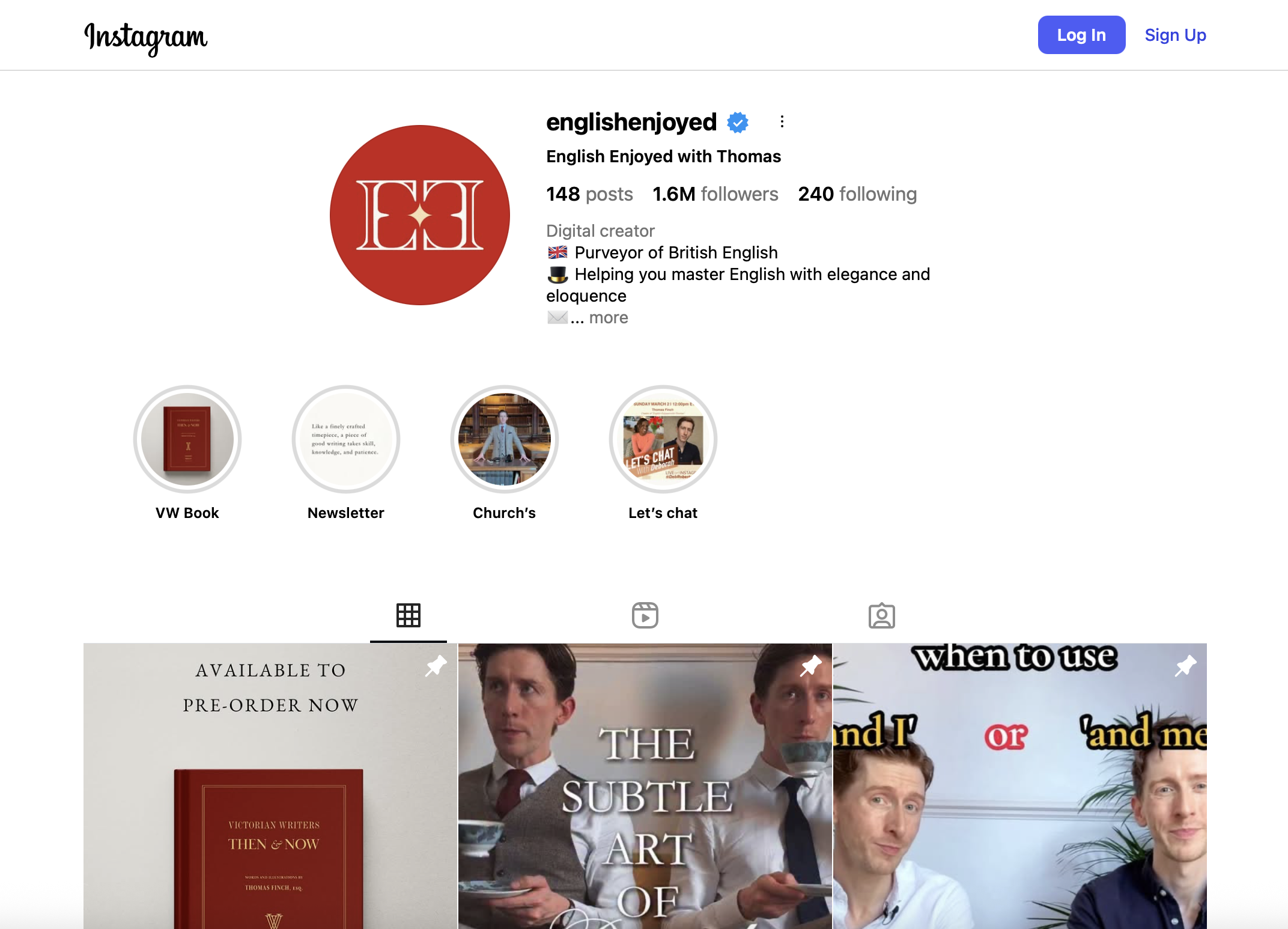
If you need some light relief as you wrangle a second language, this Instagram account will help you get a firmer grip on your first. English Enjoyed is an utter delight, best savoured over tea and scones.
French lessons, events & trips
FRENCH LESSONS EVENTS & GIFTS
If you need some light relief as you wrangle a second language, this Instagram account will help you get a firmer grip on your first. English Enjoyed is an utter delight, best savoured over tea and scones.

We love it when we stumble across an unfamiliar French word, and this month we found a fascinating one: affrèrement. Sometimes translated as “brotherment”, un affrèrement refers to a legally binding same-sex (but not necessarily sexual) union of two men that existed in France in late medieval times.
According to this article in The Atlantic (available to subscribers):
“In the contract, the ‘brothers’ pledged to live together sharing ‘un pain, un vin, et une bourse,’ (that's French for one bread, one wine and one purse). The ‘one purse’ referred to the idea that all of the couple's goods became joint property.”

Imported from Japan, listening bars are the latest craze sweeping Paris. If you have a deep appreciation of *la musique and an aversion to shouting over the doof-doof thumping through many venues, these stylish audio-centric bars are for you.
You’ll find DJs spinning vinyl – from funk to disco and house, exceptional audio systems, and inventive food offerings.
Want to get in on the listening action over a craft cocktail? Here are some of the best listening bars to drop by on your next trip to Paris.
* music
With roots in the snowy Alps in Savoie, Tartiflette is a rich, ultra-comforting dish made with potatoes, reblochon cheese, onions and lardons – cooked until until molten and golden.
While traditionally a cold-weather go-to, we think the French potato bake is irresistible all year round. Serve yours with a fresh *salade verte and crisp white wine on balmy nights. Delish!


*Bon appétit! Merci au Marmiton pour la recette.
* green salad | *Enjoy! Thank you to Marmiton for the recipe

With its distinctive round shape and glass dome, la Bourse de Commerce may be one of those French buildings you previously walked by, but it’s well worth a closer look. First serving as a commodity exchange for *le grain in the 18th Century, the historic building near Les Halles is now an art museum that has housed the impressive Pinault Collection since 2021.
A must for fans of modern and contemporary art, the minimalist gallery spaces – designed by Japanese architect Tadao Ando – feature works by renowned artists such as Jeff Koons and Damien Hirst. Admiring all that talent make you hungry? There’s also a rooftop resto with panoramic *vues.
View the upcoming *expositions on the Bourse de Commerce website.
*grain | *views | *exhibitions

Ever wondered if the French take part in trick-or-treating, or put out *les citrouilles on October 31st? While many older generations view the holiday as a crass, commercial US import, Halloween has grown in popularity in recent years.
However, it’s still completely overshadowed by a more sombre tradition that takes place the next day – La Toussaint (or All Saints’ Day). On this national holiday, families visit cemeteries to clean, decorate and place *les chrysanthèmes, which symbolise memory, on the graves of loved ones lost.
And while it may not involve a sugar hit, the occasion is also a favourite with kids as it coincides with a two-week school break, *les vacances de la Toussaint.
* pumpkins | *chrysanthemums | *All Saints’ Day holidays
A fan of bold, bright and sculptural design? It’s time to familiarise yourself with the playful world of Ekhi Busquet. A self-professed arcencielophile (lover of rainbows), Ekhi is a big deal in the French design world – in demand with iconic fashion and beauty houses for her thoughtful approach, sustainable production and vibrant pieces that spark joy.
A graduate of the École Boulle and the Politecnico di Milano, Ekhi started out in visual design for the likes of Dior and L’Oréal before setting up her multidisciplinary design studio in 2017. Splitting her time between Paris and Marseille, she draws inspiration from both.
Take a peek at her work on Instagram – particularly her “Seins-Germain” collection, supporting breast cancer awareness and co-designed with Matthieu Vergote.
Visit ekhibusquet.com

As we creep towards Christmas, it’s time to start thinking of *les cadeaux – and what better gift than a piece of arm candy in soft, buttery *cuir? Ranging from the relatively affordable and airline-friendly Longchamp Le Pliage tote to the extortionate and nigh-on-impossible to source Hermès Birkin, here is a list of the 16 most iconic Parisian bags in history. Print it out, circle your favourites and leave it lying around for *Père Nöel.
* presents | *leather | *Father Christmas

Joining us for our trip to Honfleur? Here’s a list of 10 of the best things to do in the quaint Normandy town – perfect for planning out your *temps libre.
Not coming this time? *Vous allez nous manquer, but don’t worry. We’ll be sure to raise a glass when it’s time for #8.
*free time | *We’ll miss you
From *les huîtres at Cap Ferret to tartiflette in the Alps, whet your appetite for a culinary tour of France in 10 classic dishes. Rounding up the country’s most delectable regional delicacies with a side helping of accommodation suggestions, this Guardian article is a must for any gourmand.


*oysters
Need some inspiration for your next holiday? We recommend you tune in to the fabulous Échappées belles (Great Escapes). Airing weekly on France 5 since 2006, the popular travel and discovery show is akin to a Gallic Getaway – but much more in-depth.
Each 90-minute episode does a deep dive into *une seule destination. Enjoy them at your leisure, with most episodes available to watch free on the official Échappées belles YouTube channel.
Here’s a little taste.
*a single destination
When learning a language, sometimes you just have to laugh. And it seems the French president himself has *un sens de l'humour about some of the absurdities of his own.
*a sense of humour
Penned by beloved French-Armenian singer Charles Aznavour and lyricist Herbert Kretzmer in 1974, ‘She’ is an iconic love song with two lives. Originally recorded in English (and later also in French, German, Spanish and Italian), it was the theme tune for a British TV series and reached number one success in the UK and Ireland.
However, the moving ballad didn’t reach nearly the same heights in Aznavour’s homeland, and it wasn’t until Elvis Costello’s cover appeared in Notting Hill that *le monde entier est tombé amoureux.
Learn the ‘She’ story in this instalment of ‘Once Upon a Song.’
And don’t miss the man himself singing the original version below.
*the whole world fell in love
If you’re as nerdy about the evolution of language as we are (and we know many chouchous are), this fascinating video about French negation is the perfect little treat. *Profitez-en!
*Enjoy!

Bonjour!
We’re only going to add one tiny square in this instalment, but once again, it’s an important one.
The pronunciation of words like fille* and famille* is confusing to many, myself included in the earlier years. I remember never being 100% confident even though they’re relatively basic words, and ones that come up a lot.
I can now see why I was so confused. At around the same time, I was learning some other very useful words, such as ville*, mille* and tranquille*, which, as you may know, are not pronounced in the same way as those to which I’ve referred above.
Mais pourquoi pas*? It may surprise you to know that there is a method in this apparent madness. That is, the pronunciation of each of these words can be predicted to a large degree, so it’s best to learn the rule rather than faire à l’arrache*.
This is the default rule for the pronunciation of words containing I-L-L-E. If you’re ever not sure, go with the pronunciation below. I can’t promise you you’ll be right, but you’ll at least have backed the horse with the shortest odds:
the combination of the letters I-L-L-E produces a sound I don’t believe we have in English, but which is a combination of the English letters ‘e’ and ‘y’.
To really nail the sound in French, you’ll need to go back to your anchor word for the letter i, whether that be lit*, ici*, voici* or even something else - maybe merci*?). The tricky bit is that the L-L-E letters that follow it together make a sound akin to an English ‘y’, such as the ‘y’ sound in the word ‘yellow’. So now we have a French i combined with an English ‘y’ sound. If you’re finding that hard to imagine, trying pronouncing the English word ‘key’ and emphasising the ‘y’ sound a little bit. This will get you quite close to the sound we’re after. Imagine then, that instead of saying the word ‘key’, you’re now saying the word ‘fee’ in English. Now pretend there’s a ‘y’ on the end of it. Bravo*! You’ve just made a very good pass at pronouncing the French word for girl, fille.

Now for des précisions*. Be sure to make the i sound of fille very short and tight. Remember, it should rhyme with lit, ici or voici, not the more elongated double ‘e’s of the English words ‘keep’, ‘sleep’ and ‘tree’.
famille
cheville*
Bastille
(*ankle)
Alors voilà*! This is the rule for how the I-L-L-E sound is pronounced. Facile, non*?

Now I know you’d be disappointed if there were no exceptions to this rule, so allow me not to briser ton cœur*. There are. There doesn’t seem to be any rime ou raison*, though, so here are the most common rule-breakers. With these petits rebelles*, remember to sound the ‘l’s (so ville will rhyme with the English word ‘fill’) and you’ll be sur la bonne piste*.
ville
mille
tranquille
Lille
The rest are better to learn as you go, I think. They’re fairly obscure words and even if someone does correct you, you’ll likely forget by the time you go to use them again, if you ever do (I’m still waiting for my second chance to use bacille*, for example).
By the way, if ever you have any questions about these articles, please feel free to leave a comment below and I’ll do my very best to help you.

*daughter | *family | *city | *thousand | *calm | *But why not | *take a helter-skelter approach | *bed | *here | *here is | *thank you | *Well done | * some details | *So there you go | *Easy, isn't it? | *break your heart | *rhyme or reason | *little rebels | *on the right track | *bacillus

After a French series to keep you glued to *la télé this winter? With 12 gripping episodes, D’argent et de sang (Of Money and Blood) is a stylish crime thriller following “one of the biggest financial swindles of all time”.
Inspired by a book of the same name by investigative journalist Fabrice Arfi, the series is based on true events surrounding a multi-billion-dollar French carbon tax fraud in 2008-9. The story centres on customs inspector and magistrate Simon Weynachter’s obsessive pursuit of those involved in what French media dubbed the scam of the century – a pair of Tunisian criminals from Belleville and a wealthy, charismatic trader.
Watch the trailer below and stream it now on SBS on Demand.
*the TV
For this nostalgic French confection, the clue is in the name. With ‘oursons’ meaning bear cubs or little bears and ‘guimauve’ meaning marshmallow, oursons guimauve are chocolate-covered marshmallow bears loved by kids of all ages.
Created in 1962 and produced by Cémoi since 2003, the classic commercial version, Petit Ourson Guimauve (Little Marshmallow Bear), is 6-ish centimetres and dipped in milk chocolate with a fluffy marshmallow centre.
Made in Villeneuve-d'Ascq in northern France, les Petits Oursons Guimauve are available in supermarkets across France. However, non-branded versions of the sweet little bears are also made by artisanal chocolatiers – sometimes with *chocolat noir for the more grown-up palate.
*dark chocolate
If you’re as obsessed as we are with celebs speaking French, this video is for you. From Taylor to Timothée, Bradley Cooper to Jodie Foster, watch the stars sink or swim *en français, with their language skills scored on a scale of 1 to 10. *C’est chouette!
* in French | *It’s great!
Does your winter sports repertoire begin and end with “*J’aime faire du ski?” Don’t worry, we can help. Read on and expand your horizons with this cheat sheet to *les sports d’hiver.


*I like skiing | *winter sports

Found in the 7th arrondissement with *la Tour Eiffel as a tourist-pleasing backdrop, Rue Saint-Dominique is one of Paris’s premier shopping destinations. Dating back to the 14th century and renamed in 1643 after a Dominican monastery once located nearby, the chic, vibrant street, crossed by the Esplanade des Invalides, is the perfect place to while away an afternoon.
Whether you want to give your credit card a workout or simply soak up the atmosphere and *faire du lèche-vitrines, you’re spoilt for choice with the boutiques, *boulangeries and specialty stores on offer. Plus charming cafés, bars and restaurants, ready to help you refuel.
*the Eiffel Tower | *window shop | *bakeries