
How to Learn French - all at C no longer

It is often said that learning a second language improves your mastery over your mother tongue. A few years ago, and very late in my French-learning, I learned a French pronunciation rule that helped me understand why I pronounced certain English words in the way I did. Ça a fait tilt*, I can tell you!

So here it is. In French, when the letter C is followed by the vowels A, O or U, a hard sound is produced. For example:
café
collège
cumin

However, when a C is followed by the vowels E, I (or Y for that matter), a soft sound results. Like this:
cent
merci
cymbales
The bit that blew me away? It’s exactly the same in English. Think about it:
cat
cotton
cut
but
century
city
mercy
Tell me I’m not the only person who didn’t know this! I suspect I’m not alone.
This also made the function of the c cédille (or c cedilla in English) so much clearer. That is, when the French have a word that has a soft C sound where the C is followed a vowel that usually produces a hard C, they add a ç to soften it. For example:
ça va
garçon
reçu
Ça a du sens*? I hope so.
I think that even if it’s not crystal clear right away, it will become so as you start to notice more and more examples in your workbooks. I hope, too, that as this idea firms up in your head, it will help you to feel more confident in pronouncing French words you’ve not previously seen.
Believe it or not, the rules of French pronunciation are rarely broken (I promise!) so go ahead safe in the knowledge that if you apply the rules above, you’ll almost always be right.
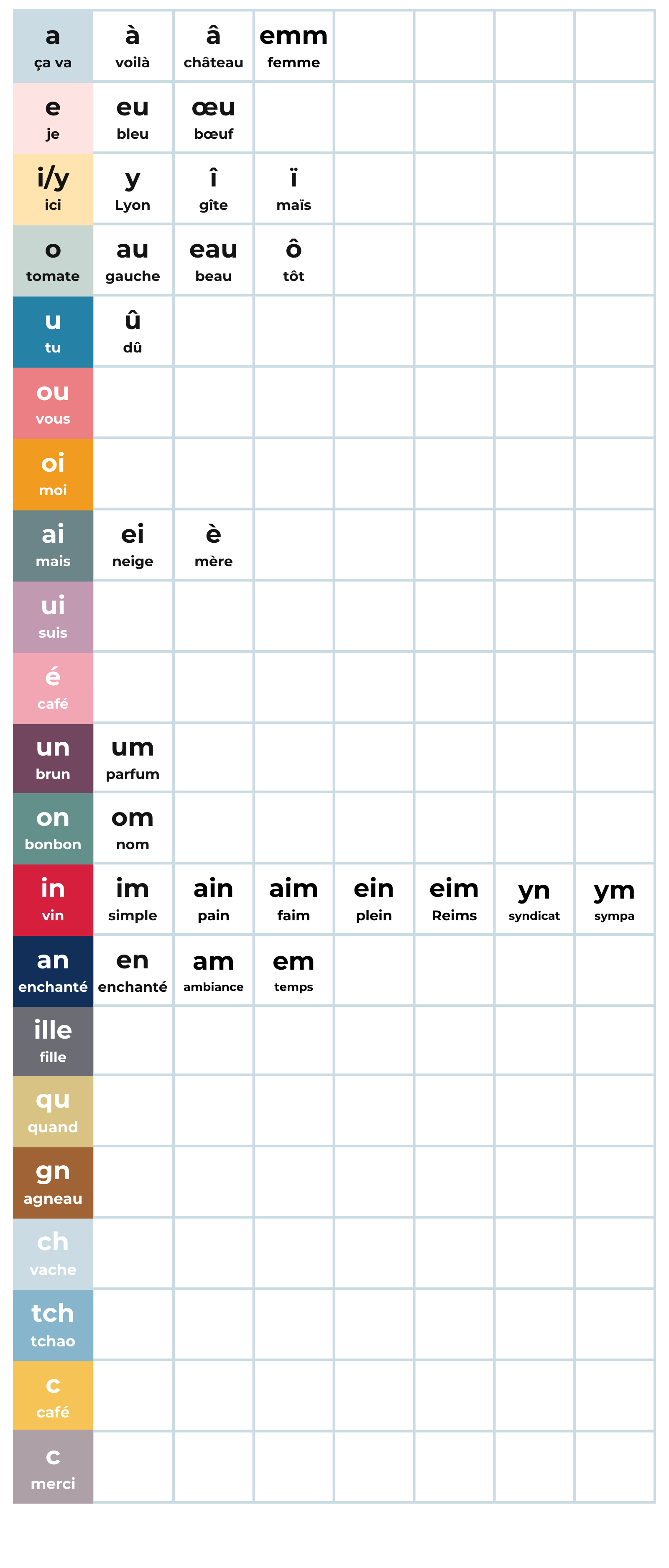
*It clicked | *Does that make sense?