Winter Sports
Does your winter sports repertoire begin and end with “*J’aime faire du ski?” Don’t worry, we can help. Read on and expand your horizons with this cheat sheet to *les sports d’hiver.
*I like skiing | *winter sports
Bref et concis* but a really good précision* for many, today we’re talking about one of the most mispronounced words in French: the word for woman (or wife), femme.
Most often, we hear this mispronounced as rhyming with the English word ‘gem’, rather than the word ‘thumb’, which the sound resembles most closely.
I remember being so surprised when I learned that the e in words containing the combination emm in French was pronounced as though it was a French a sound. If you’ve been following these posts, you’ll know that the anchor word I use for a in French is ça va. And if you’ve done your devoirs*, you’ll also know that sound is very close to the u sound in the English word ‘cup’. Read on for some more illuminations* (hopefully)…
By the way, it’s not just femme that has this English u sound. Here are a few others to ponder.
femme
évidemment
fréquemment
différemment
patiemment
If you’ve been trying out your French on native-speakers for a decent period of time, I am confident you would’ve already been (kindly) corrected on your pronunciation of the word évidemment. I certainly was (more than once, until it clicked), but I thought it must have been an exception. In fact, it’s not, it’s just that the combination of emm in the middle of a word makes that ‘u’ sound we’ve been talking about.
Alors, voilà!* Only one square added this time, but an important one, nonetheless.
*Short and sweet | *clarification | *homework | *lightbulb moments | *So there you go
Get your forty winks now, cycling fans, because Le Tour is back – and you know what that means. Kicking off on 5th July, the 112th edition of the premier international cycling event, Le Tour de France, will see 23 *équipes traverse 3,320 kilometres of picturesque terrain over three action-packed weeks. As plenty of eager Aussies swap sleep for late nights glued to SBS.
Want to impress your colleagues at the water cooler with your informed cycling chat? Here are a handful of phrases to pedal out in the local lingo.
You can find a more comprehensive list here.
*teams
Hopefully since the last post you’ve reflected on the sentence below, which contains all four nasal vowels. A nasal vowel is a vowel followed by an ‘n’ or an ‘m’, as you may remember.
This post is devoted to those nasal vowels followed by ‘m’s, as well as some variations in spelling, for nasal vowels containing both ‘n’s and ‘m’s.
The good news is, there’s really nothing new to learn here, as these nasal sounds are pronounced exactly as those above. You will, see, however, that our grid has a bit more girth these days, which I hope you’ll perceive as a broadening of your pronunciation skills.
The aim today, therefore, is simply to notice this fact, and of course, have fun choosing your anchor words. Allez-y*!
There are very few words containing this sound, but here’s one you likely know.
humble
For those of you with eagle eyes, you’ll have now realised that the following two words are pronounced exactly the same:
non
nom
I hope this is reassuring to you, reducing, as it does, the options for pronunciation.
Here are some other words containing om that you may know:
comptable
ombre
comptoir
plombier
This sound certainly spreads itself around and is found in the following spellings. Remember, all of these sounds are pronounced exactly the same as the in in vin, despite the various ways they appear on the page.
pain
faim
plein
Reims*
syndicat
sympa
Okay, okay, this most particular of place names does break the rules of pronunciation, I admit, but probably not where you think it does. It is just the pronouncing of the final ‘s’ that is unusual. The rest of the word conforms to the rules and is therefore pronounced similarly to the word ‘dance’ in Australian English (that is, if you don’t pronounce it ‘dahnce’. Tu vois*? English is aberrant, aussi*!)
Remember, these nasal vowels rhyme with those found in enfant, which, helpfully, rhyme with one another.
jambon
framboise
champignon
ambulance
exemple
embouteillage
embrasser
température
Et voilà*! I hope you can see the strides you’re making now that we’ve laid the foundations of French pronunciation. See you next month for more!
*Let’s go! | *You see | *as well | *And there you go
If you prefer your holidays far from bustling cities and crammed coastal resorts, with a healthy dose of fresh air, Lonely Planet’s guide to the best hikes in France might be for you.
And, to ensure you fit right in on *la piste, we’ve also compiled *une liste of handy French hiking vocab to learn before *votre depart.
*the track | *a list | *your departure
If you’ve become a regular reader of these posts, you may remember we started our pronunciation adventure all the way back with the vowels a, e, i (y), o and u. I hope by now you feel confident pronouncing them and that you know your anchor words off by heart.
If you’re new to the blog, the use of anchor words is a fairly common practice for those learning to pronounce a second language. These are words that you absolutely know how to pronounce and by extension allow you to pronounce a whole host of other words that contain the same sounds. Apart from the exceptions, (bien sûr*).
I can almost hear you howling from here about French and its plentiful exceptions, but I promise you that on the pronunciation side of things, at least, there are very few exceptions to the rule. Don’t believe me? Follow this blog to the bitter end and you’ll see that the pronunciation table we’re building has a form to it that will satisfy even the most méticuleux* of reader.
Today we’re going to look at nasal vowels, which for me are what makes French sound so…well, French. If you think of a caricature of a French person (say Pepé Le Pew or Steve Martin as Inspector Clouseau) their overblown accents are often due to an exaggeration of the four nasals vowels. Read on to find out un peu plus*.
By the way, here are my personal anchor words for the French vowels. Please do not feel hidebound by mine. While you’re welcome to use them, it is a really great exercise for you to find your own.
LES VOYELLES FRANÇAISES - KATRINA’S ANCHOR WORDS
A - ça va
E - je
I/Y - ici
O - tomate
U - tu
Okay, so now let’s take a look at these very special-sounding vowels - les voyelles nasales*.
Step 1…
This (admittedly) very memorable French phrase encapsulates the nasal vowels in one easy-to-understand sentence: a good white wine.
There are officially four different nasal vowels in French, though many French people will say the sounds un and in sounds are exactly the same. While it’s true the difference is très nuancée*, each have separate phonetic symbols so for now at least, we have quatre* to learn. Don’t worry, though, if you can’t hear the difference between the two. In a hundred years or so, there will likely only be three of them and you’ll have been proven right.
Choose your favourite word below to become your anchor word. There are actually very few words that contain un in French. Next post you’ll see that the sound um is exactly the same (see, I told you it’d get easier!) so there’ll be a few more of them to choose from.
un
lundi
quelqu’un
aucun
chacun
MAKE THE SOUND: Try saying ‘un’ as in ‘unhappy’. Now say it again, but don’t say the ‘n’. This sound approximates the sound you want.
bon
mon
tonton
chanson
oncle
MAKE THE SOUND: Try saying the English word ‘on’. Now say it again but do not pronounce the ‘n’. Your mouth should finish open, not with your tongue on the roof of your mouth.
cousin
intelligent
fin
lapin
prince
MAKE THE SOUND: Try saying the English word ‘an’ as in ‘an apple’ without finishing the ‘n’ sound. This is quite close to the sound you’re after.
enfant
enfin
dans
antique
dent
MAKE THE SOUND: The two sounds are identical. Think of the word enchanté, in which it appears twice.
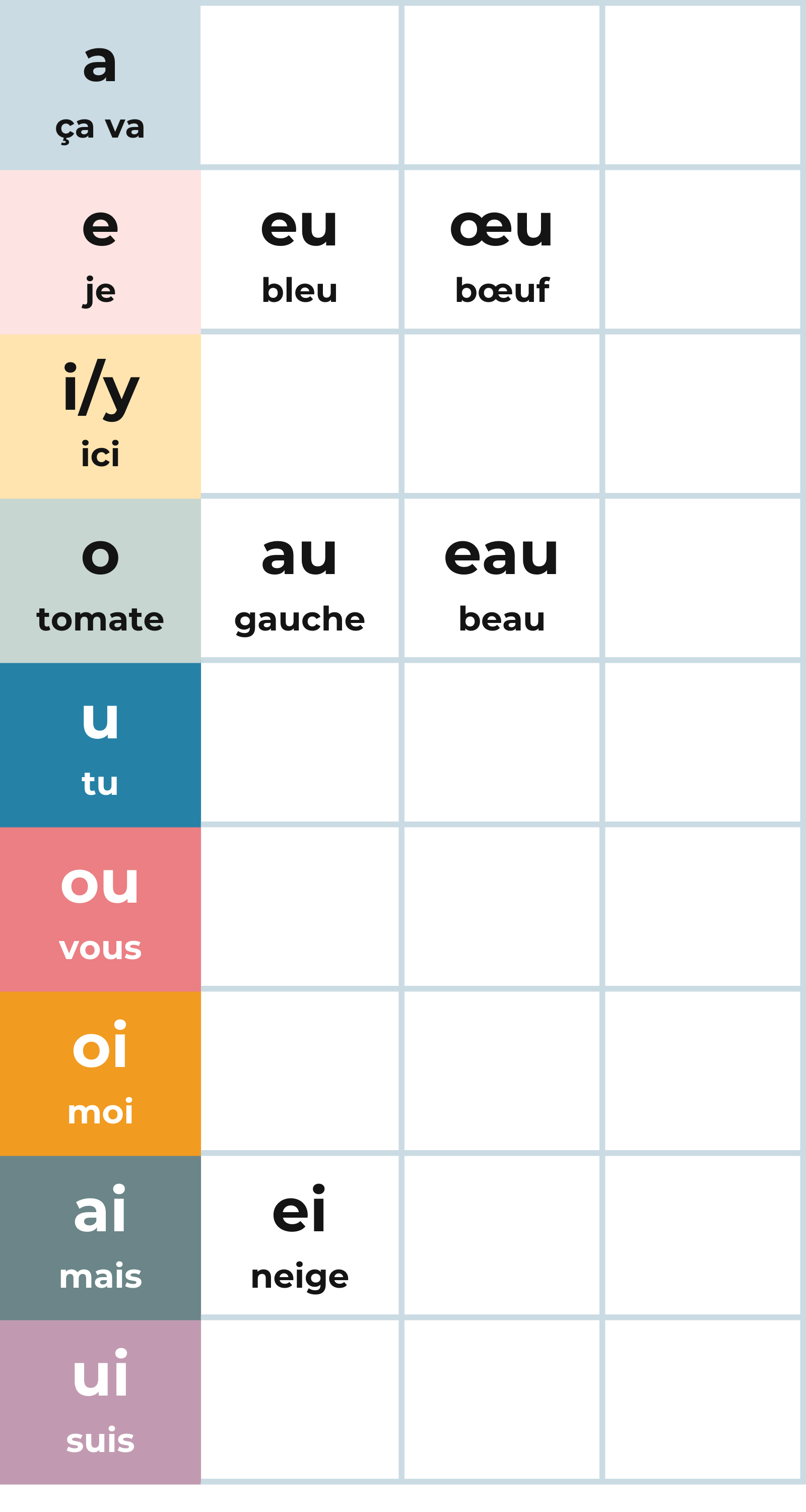
So, let’s take a look at our pronunciation table after the addition of the nasal vowels. You’ll see we’ve added four extra rows, as the sounds are completely different to all those that have preceded them.
Ne vous inquiétez pas*, though, next post we’ll fill out those new rows in a really satisfying (and hopefully helpful) way.
*of course | *meticulous | *a bit more | *the nasal vowels | *very nuanced | *four | *Don’t worry
Like all of us, the French love a long weekend. Especially when the calendar allows them to ‘faire le pont’. With the literal translation ‘to make a bridge’, this fun French expression refers to asking HR for an annual leave day to create an extended four-day weekend.
How does it work? If un jour férié (public holiday) falls on a *mardi ou jeudi, it’s common practice to take off the bridging day (Monday or Friday) to create a *plus long weekend.
And this year, *mai dishes up the perfect opportunity, with *des jours fériés on the 1st, 8th and 29th. All of which happen to fall on a Thursday. *Quelle chance!
*Tuesday or Thursday |*longer |*May | *public holidays| *How lucky!
Today we’re going to inch across a few columns, filling out variations on some sounds you already know well. It is my hope that with each horizontal move, you’ll be reassured that you’re more unconsciously competent at French pronunciation than you may think.
Soyez tranquille*, we’ll be making some more vertical moves in future posts, adding brand new sounds, but for now, let’s just consolidate some of the vowel sounds you already know.
You’ll notice that the additions we make today involve accents, which is to say that in many instances, they make no difference to the pronunciation of vowels at all.
On y va* !
Remember, the aim of the game is to have an anchor word for each principal sound (those in the far left-hand column below). Once you’re confident that you know how to pronounce that sound, you can start to add other sounds, which, though spelled slightly differently, have the same pronunciation.
voilà
là
à la carte
château
gâteau
pâtes
SOUNDS LIKE: A
Lyon
pays
Yves
gîte
île
dîner
maïs
naïve
aïoli
SOUNDS LIKE: I
tôt
hôpital
hôtel
SOUNDS LIKE: O
dû
brûlé(e)
flûte
SOUNDS LIKE: U
So, where does that land us? You’ll see we’ve filled in the vowel sounds quite a lot horizontally. You’re really starting to build up a very good pronunciation cheat sheet, except it’s not cheating at all, since you’re (hopefully) confident with your anchor words, and, by extension, those that follow.
Félicitations* ! You’ve just made further headway in mastering French pronunciation.
*Rest assured | *Let’s go | *Congratulations
Familiar with the English proverb, “April showers bring May flowers”? *Alors, the French have one of their own.
Referring to the fickle April weather, the saying goes, “En avril, ne te découvre pas d'un fil." This is often followed by the second line, "En mai, fais ce qu'il te plaît."
The literal translation is, “In April, don't remove a thread” and "In May, do what pleases you." Or, in other words, don’t risk swapping *tes pulls for summer dresses just yet, as the hints of warmer weather can't be trusted.
In the milder month of May, on the other hand, you’re free to do (and dress) as you like.
*C’est mignon, non?
* Well | *your jumpers | *It’s cute, right?
I think one of the biggest breakthroughs I had with my French pronunciation was when I realised how many different spellings there were for the same sound.
This realisation helped me to start to synthesise all the different information I had swirling around my head from things I’d heard, been told and read.
As much as I I like to think of myself as a creative soul, I do love a good spreadsheet, so being able to give order to the sounds I was trying to pronounce was a great help.
In the last two posts of How To Learn French, I’ve effectively been opening a new file and working out how many columns and rows I’ll need. In this post, we’re going to take our first look at that grid, so hopefully for the more visual among you it will be very helpful.
Here’s where we were after the first post.
After the second, you could see we were starting to fill in a couple of the rows, demonstrating that there is some order, in fact, to French pronunciation.
Today we’re going to add another couple of very important rows and fill out a column or two, so let’s get to it. On y va* !
Remember, our aim is to set you up with an anchor word that you are confident about pronouncing. This accent produces a sound doesn’t really have an exact equivalent in English. It’s sort of a mix between ay as in hay, and e as in bed. Here are some other options.
étudiant
risqué
étage
préférer
école
This sound is similar to the e sound in egg, or bed. As an anchor word, you may prefer one of the below, or may already have a favourite.
père
après
frère
grève
très
So now, we can fill out our table a little more and hopefully it’s becoming clearer to you just how much crossover there is in the French spelling of sounds (and there’s even more to come).
Have fun playing around with these sounds. I remember it took me ages to get my head around this. Even now, someone will correct my pronunciation or I’ll come across a new word and I really enjoy seeing if I can find a place for it in the grid. I hope you’re finding this helpful.
Bon courage* !
*Let’s go | *Good luck
In the last How To Learn French post, I introduced the concept of anchor words as a way of improving your pronunciation. Anchor words are words that students absolutely know how to pronounce. They’ll be different for everyone, but the trick is to start gathering a little stock of your own which you can use to refer to in order to at least have a very good stab at pronouncing new words correctly.
French pronunciation has a reputation for being difficult, but I think this stems from a misunderstanding. Yes, French certainly has sounds that do not in any way resemble English, however, the good news is that they do resemble one another in many cases. That is, there are several ways of spelling the very same sounds in French.
So, to get going, let’s take a look at the ones we covered last time, and then we’ll advance from there. Un petit rappel*, if you’d like to be 100% sure of the pronunciation of any of these words, make the most of this great little website, where you can hear a variety of native speakers saying them. It’s a very good resource and one I still use when I’m faced with a word I’m not entirely certain how to pronounce.
A comme* ÇA VA
E comme JE
I/Y comme ICI
O comme TOMATE
U comme TU
We’re going to tackle dipthongs, which are vowel combinations that create a syllable. Ne vous inquiétez pas*, even if you’ve only been learning French for a very short time, you’ll have come across them already, possibly without realising it. A classic example is found in the word bonjour, where the o and the u produce a particular sound.
You’ll notice that some of the sounds below are exactly the same as the anchor words above. Tu vois*? French pronunciation is already becoming easier.
My hope is that learning how certain sounds are grouped will not only take away the guesswork, but will start to arrange French pronunciation into a grid format in your mind, replacing what may currently look more like you’ve upended a cylinder of pick-up sticks from a great height in a strong wind.
où
douze
voudrais
bouteille
deux
neuf
heure
sœur
SOUNDS LIKE: E comme JE
trois
poisson
chinois
toilettes
raisins
treize
seize
retraité
bureau
château
restaurant
gâteau
australien
SOUNDS LIKE: O comme TOMATE
nuit
huit
oui
huile
As we continue with growing your collection* of anchor words, you’ll see that many of them start to refer back to our original group. I’d really encourage you to start keeping a little list in the back of one of your notebooks to refer to. I think you’ll be happily surprised by how quickly you’ll discover that French pronunciation is not only beautiful, but also rather orderly and comprehensible. In fact, it’s one of the rare elements of French where exceptions are truly exceptional, rather than the rule. Lâche pas*!
*A little reminder | *as in | *You see | *Don’t worry | *collection | *Don’t give up
‘Tis the season to perfect your French vocab with this handy list of festive terms. From holiday greetings to the baubles decorating your sapin de Noël*, pop these up your sleeve to spread the holiday cheer like a pro.
*Christmas tree
In the last How To Learn French post, I mentioned that there are certain things that seem to trouble most learners, regardless of their level. I named the letters e and i in the French alphabet as particular bugbears.
So for this post, I thought I’d share one of the techniques I learned when it was time for me to really come to grips with French pronunciation. It may surprise you to know that it wasn’t just before my Year 12 exams, or in preparation for moving to Paris many years later. It wasn’t until I started tutoring French upon my return that I realised I’d been approximating many of the French sounds until that moment.
Looking back, I know my accent was okay, but it wasn’t until I sat down with The Good Pronunciation Guide put out by Bien Dire publications (very highly recommended) that it dawned on just how loose a lot of my pronunciation was. In an effort to tighten it up, I pored over the little booklet that came with the CD (yes, it was il y a longtemps*) for many, many hours. As frustrating as it was (at times I wanted to tear my hair out) it was ultimately very illuminating.
With the booklet’s help, I was able to group together combinations of letters and accents that made the same sound. For example, the sound è can be written in a variety of ways: è, ai, ei and ê, to name a few. We’ll get into that in a future post, as I can see I’m already starting to get ahead of myself. Before learning the different spelling combinations for a particular sound, we need to have a fail-safe way of remembering the sound itself. Enter the idea of anchor words.
An anchor word is a word a student already knows how to pronounce and can therefore recall easily. We use these words as a reference point to ensure our pronunciation stays on track and doesn’t drift along in the linguistic tides.
So, let’s get right into by taking a look at the French vowels. I’ve offered up my personal anchor words, but feel free to choose another from the ones I’ve listed, or encore mieux*, come up with your own. I’d really recommend you start a little list in a notebook you can access at all times. I think you’ll be surprised by how reassuring it is and therefore how often you’ll reach for it.
By the way, if you’re not absolutely sure of the pronunciation of my anchor words, you can check on this very helpful little website.
Others you might like:
la
ma
voilà
baguette
chat
Others you might like:
le
me
de
demain
revoir
lit
Lyon
Fifi
midi
Paris
Others you might like:
orange
dos
trop
photo
gogo
Others you might like:
bus
jus
tutu
uniforme
lu
Remember, the more you identify with a word, the more likely it is to come to mind when you need it.
Next time, we’ll look at some vowel combinations (like oi, ui, ou and others) and hopefully you’ll start to see how quickly you can combine the sounds in your anchor words to confidently pronounce words of more than one syllable, and, with a new degree of confidence, even words you’ve never come across before.
Bon courage*!
*a long time ago | *even better | *Good luck
As a fairly obsessive person in many ways, I can get myself into a bit of a lather from time to time.
It can be a positive (it’s the things I’m passionate about that tend to trigger this character trait in me) but at times it really works against me. I know I’m in its grip when I find my mind racing and my breathing shallow, thinking to myself “how am I going to get there FASTER?”.
Over the years I’ve read dozens of self-help books, studied philosophy and taken up meditation and these practices have undoubtedly helped. However, it’s one simple piece of advice, offered up to me many years ago, that now has the power to make me take a breath when I can feel myself winding right up.
I joined Qantas as an international flight attendant straight out of university, at the tender age of 23. I’d barely travelled before that point and after six weeks of training was sent on my very first trip. I was beside myself with excitement and fronted up to the briefing room at the jet base in Sydney, groomed to within an inch of my life and proudly wearing my brand new navy blue uniform and regulation pantyhose. I’m surprised I didn’t salute as I went in to meet the rest of the crew, so primed was I to make long-lasting friendships based on extraordinary shared travel experiences.
In those days, trips were allocated on a seniority basis, but because I was brand new, I’d been called out on a trip to a very desirable (and therefore very senior) destination: Tahiti. Where my training class was full of highly excitable, nervous goody-two-shoes like me, desperate to toe the company line by going ‘above and beyond’, my first crew was a ragtag bunch who barely bothered to look up as I awkwardly entered the room.
Relieved I’d decided against the salute, I quietly took a seat at the back and had no choice but to listen in on their off-hand, world-weary exchanges about what they were going to get up to in Tahiti during their slip time. They were all about 20 years older than me and wore their uniforms with an insouciance that would have had them reported tout de suite* in the training rooms upstairs. Sunglasses pushed onto the tops of heads, jackets slung over the backs of chairs, ties undone, skirts riding up to reveal non-regulation (gasp!) stockings… Louche was the only way to describe it and yet I was in absolute awe. How could these people get away with breaking all the rules and be so incredibly cool simultaneously? Remembering back to how naive I was makes me cringe and smile all at once.
Cut to two hours later and we’re ready to greet the passengers as they file onto the aircraft, anticipating their trip to paradise. Without any to-do whatsoever, uniform jackets had been buttoned, sunglasses removed, skirts pulled down to graze the knees and cigarettes stowed within arm’s reach for the minute the no-smoking sign went off (yes…). I watched as my fellow crew members greeted, assisted and gently teased the passengers in that most Australian of ways. “Got ya boardies with ya, mate?” to a young boy travelling with his parents. “Looking forward to your first Mai Tai, doll?” to an older woman who tittered in appreciation. It was a different time, that’s for sure, but the ease with which they dispensed their charm across the entire economy cabin was truly a sight to behold.
Meanwhile, I could barely distinguish one end of the aircraft from the other and yet couldn’t let go of my newly-acquired policies and procedures training, swirling though they were in my head.
Picking out the most approachable-looking of my colleagues, I started peppering him with questions.
“So we do waters pre-take-off and then once the seatbelt sign goes off we start the bar service, is that right? Or do we hand out the menus first? Oh, no, I remember,” I said, answering my own question, as my colleague’s moustache betrayed a small smile, “we do headsets first up, or is that before take-off? Do I get them out myself, or have you already done that? Where are they again?”
“Easy, tiger, it’s a long flight. You don’t want to puff yourself out.”
I wish I could report that those words snapped me out of my self-imposed stress coil, but they didn’t. They did make me laugh, though, and over the next eight hours or so I was able to witness the crew pace themselves in a way that ensured the passengers got what they needed (food, drink, safety) as well as what they wanted: a comfortable flight, a quick chat and a bit of a laugh.
So, why am I meandering down memory lane and how does it relate to learning French?
One of the great things about my job as a tutor at Lingua Franca is that I have the privilege of teaching people who choose to be there. They lead busy, interesting lives, yet find time once a week or more to turn their attention to French. I love watching the French bug bite them and know it’s happened when they start a sentence with : “I was in the shower/car/supermarket the other day and was trying to work out how I’d say…”
This is such a wonderful development and one that should be celebrated.
However, sometimes that passion can spill over into anxiety and I’ve seen people giving themselves a hard time instead of giving themselves a huge pat on the back, which is what they deserve.
If you recognise yourself in this description, I offer you a few observations:
As tutors, we teach many classes across all sorts of levels and we can report with confidence that almost every French learner struggles with the same things. A couple off the top of my head:
the letters ‘e’, ‘i’, ‘g’ and ‘j’ in the alphabet
the numbers 14, 15, 40 and 50.
how to ask for water
It’s not just you, I promise.
It’s a cliché, but there really are no dumb questions. You are literally learning a different language, so of course there’ll be things that just don’t make any sense. As a tutor, I’m always happy when someone says “This may be a dumb question, but…” as it just alerts me to the fact I haven’t explained something clearly enough. And I know that in offering a more careful answer the second time around, I’ll be helping those who didn’t speak up.
You have to be resilient to stick at learning a language. If you’ve been learning for any length of time, you’ll know there are days when things really seem to be clicking. Your mind’s sharp, your conjugations are impeccable and you may even surprise yourself by thinking “What I just said sounded pretty French!” And then there are the other days… Your head’s like cotton wool, you can’t even think of the verb let alone conjugate it and you may wonder why you embarked on this folly in the first place. Try not to be too disheartened. In my experience, it’s usually down to a lack of sleep or a bit of stress, or it may simply not be your day.
Learning French can be an absolute pleasure, but beware of turning it into a chore in your enthusiasm to get to an arbitrary finishing line. Just like my Tahiti crew who built up their skills over a number of years, you’ll one day meet a newbie and think “Easy, tiger. You don't want to puff yourself out.”
*straight away
You may know the French expression faire attention meaning ‘to be careful’. But do you know less formal faire gaffe? It, too, means to pay attention or be careful, even to watch out. and this is exactly what we want you to do with these common faux pax* which are easy to avoid once you’re aware of them.
ABSOLUTE BEGINNER
We’ve spoken about apostrophes before but it bears repeating. Ignore them! Same goes for the letter ‘h’, which is always silent in French.
What we often hear at Lingua Franca: Je habite
What we’d love you to say: J’habite* (sounds a bit like: juh-beet)
BEGINNER
Lingua Franca Chouchous* are a happy lot en général* and often want to tell us they’ve had a good time. Unfortunately a word-for-word translation doesn’t cut la moutarde* in this instance.
What we often hear at Lingua Franca: J’ai eu un bon temps.
What we’d love you to say: J’ai passé un bon moment*.
INTERMEDIATE
The phrase il y a is nothing if not versatile. It can mean: ‘there is’, ‘there are’, ‘is there?’, ‘are there?’ and even ‘ago’ if placed before a time period.
What can be difficult to grasp when you’re first learning is that the ‘a’ in il y a is in fact a conjugation of the verb avoir*. So when you want to use this expression to indicate the past (the imperfect tense, to be exact), you’ll need to conjugate the verb accordingly.
What we often hear at Lingua Franca: Il y était.
What we’d love you to say: Il y avait*.
ADVANCED
Wouldn’t life be so much more simple if we used the verb visiter (to visit) in every situation? No such luck I’m afraid.
Visiter is certainly used in French, but only for visiting places and things, not people. To say that you visited your parents, for instance, you’d need to employ the phrase rendre visite à (literally ‘to render visit to’).
To break it down a bit, rendre is the verb ‘to give back’, ‘to render’, or more colloquially ‘to make’. It’s a regular -re verb and therefore its past participle is rendu.
Please pay special attention to the next word: visite*. In this phrase, it’s not a verb but a noun. Note, too, that it isn’t preceded by a definite or indefinite article (la* or une*). The good news is that, as a noun, there is absolutely no need to change it to suit the person doing the action or, indeed, the tense.
Lastly, remember to add the preposition à (to) and you’re home and hosed.
What we often hear at Lingua Franca: J’ai visité mes parents.
What we’d love you to say: J’ai rendu visite à mes parents*.
*mistake (literally: false step) | *I live | *Teacher’s Pets | *in general | *the mustard | *I had a good time | *to have | *There was/were | *visit | *the | *a | *I visited my parents
Keen to speak like a true French native? It’s time to master Verlan – a form of French slang created by inverting the syllables (or sounds) in a word. Un exemple*? Try cimer – the cool-kid way to say merci*.
Check out this article on the 15 Verlans words you should know. And be prepared to impress your French amis*.
*An example | *thank you | *friends
If you've ever done a group lesson here at Lingua Franca, you've probably come into contact with La Petite Histoire*. A tale with the very humblest of beginnings, it winds up becoming a rollicking schlockbuster as you move up the levels and your French improves enough to handle the outrageous (some would say impossible) turns of events of the six young friends.
La Petite Histoire is currently only available to our students, however La Préquelle is for everyone’s enjoyment. Below, another instalment of this new series, Chapter 2 of the Advanced 2 level.
*The Little Story | *The Prequel
Après avoir passé quelques heures très agréables à boire du Pimm’s sur la terrasse, Robert est sorti de la cuisine pour nous appeler à dîner. Alors que nous nous installions autour de la grande table en chêne de la salle à manger, je me suis enfin sentie assez détendue pour prendre le temps d’apprécier où j'étais.
J’ai souri en regardant Anouk montrer à Beth ses dessins des canards qu’elle avait tellement aimés à Hyde Park. Beth avait la patience d’un saint, écoutant ma fille babiller dans un mélange de langage bébé en français avec quelques mots d’anglais ajoutés pour faire bonne mesure. De l’autre côté de la table, Amina a gloussé tandis que Michael la taquinait à propos de sa prononciation du mot « sheets » en anglais quand elle est arrivée chez eux il y a des années. Hervé regardait avec fierté, ne suivant pas totalement la conversation mais appréciant sa légèreté et le rire cristallin de sa femme. Robert, grand et élégant, faisait tout un spectacle en découpant le rôti de bœuf, transférant soigneusement les tranches sur les assiettes empilées devant lui et demandant à son fils Michael de les distribuer autour de la table.
Même si les images d’harmonie domestique devant moi étaient indéniablement charmantes, j’ai réalisé que c’était plus un sentiment que la scène elle-même qui me rendait si satisfaite. La chaleur avec laquelle les Proctor nous avaient accueillis chez eux était remarquable, surtout étant donné que leur seule vraie connexion était avec Amina.
Involontairement, mes pensées se sont tournées vers ma propre vie familiale, et j’ai pâli en réalisant que, bien que Jean-Louis et moi puissions facilement reproduire l’image de la famille parfaite, la chaleur et l’attention nécessaires pour compléter ce tableau n’étaient tout simplement pas là. À la place de la chaleur, il y avait de l’oppression, et à la place de l’attention, de la méfiance. Désespérée d’échapper à cette prise de conscience, j’ai levé les yeux et croisé directement les yeux bruns et liquides de Simon, qui a soutenu mon regard pendant un long moment, une expression de douleur traversant son visage avant que Michael n’attire son attention en disant : « Tiens, Si, celle-là est pour Leïla. Sauce à la menthe en extra. Papa pense que ça l’aidera avec son anglais. » Simon a souri à son père avant de me tendre l’assiette : « L’anglais de Leïla n’a pas besoin d’aide, fais-moi confiance. »
« Comment tu le sais, Michael ? » demanda Michael. « Tu es arrivé il y a à peine quelques heures et Leïla n’a presque pas dit un mot depuis que nous nous sommes assis. Vous avez eu une leçon d’anglais secrète dont nous ne savons rien cet après-midi ? »
« Non, bien sûr que non – » a commencé Simon, avant que j’intervienne.
« Je suis désolée, Michael, je m’excuse d’être un peu silencieuse. Je pense que je suis un peu fatiguée, mais je profitais aussi simplement d’un moment de calme après tous nos déplacements des derniers jours. Ça fait vraiment du bien d’être ici, à profiter de ce moment en famille, même si je suis une intruse. »
« Ne sois pas ridicule, » a répondu Robert, en lançant un regard désapprobateur à Michael. « Michael aime juste taquiner son grand frère. Ne fais pas attention à lui. »
« Oui, désolé, Leïla, c’était juste pour rigoler. Tiens, laisse-moi t’en donner un autre pour me faire pardonner, » a dit Michael en me tendant le plat de pommes de terre rôties. « Avant que Simon ne les mange toutes, » il a ajouté, incapable de résister à une dernière pique.
J’ai souri faiblement et commencé à savourer mon rôti, bien décidée à me débarrasser des pensées intrusives qui me hantaient à propos de ma soi-disant vie parfaite à Paris.
After a very enjoyable couple of hours drinking Pimm's on the patio, Robert came out from the kitchen to call us in for dinner. As we settled in around the large oak table in the dining room I was finally relaxed enough to take the time to appreciate where I was.
I smiled as I watched Anouk showing Beth her drawings of the ducks she’d loved so much in Hyde Park. Beth had the patience of a saint, listening to my daughter babble on in a mixture of French baby talk and the odd English word thrown in for good measure. Across the table, Amina giggled as Michael teased her about her pronunciation of the word “sheets” in English when she first arrived at their home all those years ago. Hervé looked on proudly, not entirely following the conversation but enjoying its levity and his wife’s tinkling laugh. Robert, tall and handsome, was making quite a show of carving the roast beef, carefully transferring the slices to the plates stacked in front of him and instructing his son Michael to pass them around the table.
Though the images of domestic harmony before me were undeniably charming, I realised it was more a feeling than the scene itself that made me feel so utterly satisfied. The warmth with which the Proctors had welcomed us into their home was remarkable, especially since their only real connection was with Amina.
Involuntarily, my thoughts turned to my own home life, and I blanched as I realised that though Jean-Louis and I could replicate the picture of the perfect family with ease, the warmth and care required to complete the package was just not there. Instead of warmth was oppression and in place of care was suspicion. Desperate to escape this realisation, I looked up and straight into the liquid brown eyes of Simon, who held my gaze for a long moment, a look of pain passing across his face before Michael caught his attention by saying “Here you go, Si, this one’s for Leïla. Extra mint sauce. Dad reckons it’ll help with her English.”
Simon smiled at his father before passing the plate to me “Leïla’s English needs no help, trust me.”
“How do you know, Michael?” asked Michael. “You only arrived a few hours ago and Leïla’s barely said a word since we sat down. Did you two have a secret English lesson we don’t know about this afternoon?”
“No, course not - “ started Simon, before I jumped in.
“I’m sorry, Michael, I apologise for being a bit quiet. I think I’m a bit tired but I was also just enjoying being still for a moment, after all our moving around the last few days. It feels really good to be here, enjoying some family time, even if I am an interloper.”
“Don’t be silly,” countered Robert, shooting Michael a disapproving look. “Michael just loves to tease his big brother. Don’t pay him any attention at all.”
“Yeah, sorry, Leïla, just teasing. Here, let me give you another one to make it up to you,” said Michael, offering me the dish of roast potatoes. “Before Simon scoffs them all,” he added, unable to resist a final dig.
I smiled weakly and tucked into my roast dinner relish, determined to rid myself of the intrusive thoughts plaguing me about my so-called perfect life back in Paris.
We’re going to take a detour this month as a recent trip across the border has given me a fresh perspective on French pronunciation.
A few weeks ago, a group of Chouchous* and I headed south into Northern New South Wales to work on our French. Locked away for a weekend in a beautiful wooden cabin allowed us the time to take a deeper look at the mechanics of French pronunciation.
I say this all the time, but I’m not sure it resonates with beginners particularly: French pronunciation is not that difficult. Granted, French has sounds that we in English do not have (and vice versa - ‘th’ for example), but once you know the rules of French pronunciation it is remarkable how uniformly those rules are applied. It is, in fact, quite rare to encounter exceptions. Even the notoriously-difficult-to-pronounce champagne capital of Reims deviates in only one aspect (the pronouncing of the final ’s’). The rest of the word follows the rules, je te jure*.
I think the problem lies not in my message but in my choice of audience. When people are first learning French, so much is new: different spelling, different sounds, different grammatical structures, different numbering systems (quatre-vingt-onze*, anyone?) that it’s simply a bridge too far for an overwhelmed brain to believe that French pronunciation is arguably much easier than English.
The Chouchous that came to the weekend immersion, however, had been at their French for a little longer and were therefore able to entertain this notion, at least.
We used a series of flashcards to group together different spelling combinations that produce the same sound. An example would be would be the o in tomate* and the au in australien*. Once we had our groups, we then divided up some of the hardest French words to pronounce by sound. The true test came when we took on the French word for squirrel, écureuil (é / cu / reu / il) and I’m happy to report the Chouchous passed with flying colours.
So when I took a look at the list of words in my notes for the article this month and saw the word lieu*, I decided to take un petit détour*. We’ll look at the top five mistakes intermediate learners make in a future article. For now, I’d really like to show you how you can break down French words into sounds to pronounce them with a lot more confidence.
So, here we go. We’re going to learn two sound groups in order to be able to pronounce the word lieu like a pro.
The letter e in French is pronounced very similarly to the first two letters in the English word earth. Of course, if you know your French alphabet, you’ll already know the exact pronunciation.
Alternatively, we all know how to say the French word je, meaning ‘I’. This is the sound you’re after.
The colours are some of the first French words you learn as a beginner, and the colour blue is usually right at the top of the list. The eu sound is bleu is exactly the same as the e sound in je, and by extension, the ea sound in earth.
By the way, another member of the e sound group is œu. This strange little melding of the letters o and e is called the œ ligature in English and (cutely) l’e dans l’o in French (the e in the o). Think of words like œuf (egg), sœur (sister), bœuf (beef) and cœur (heart), among others.
For pronunciation purposes, it functions as a plain e and therefore the combination of œ and u is the same as the eu in bleu. Facile, non*?
Ici, meaning here, is another word we learn right at the start and je suis confiante* that you all know how to pronounce the i sound properly.
If you need un coup de main*, think of the i sound in the English words ‘big’, ‘lift’ and ‘tip’.
So, if we separate the word lieu into its two sound groups, you’ll have the following:
I’m pretty sure you can take it from here…
Bon courage*!
*Teacher’s Pets | *I promise | | *Easy, isn’t it? | *91 | *tomato | *Australian | *a little detour | *I am confident | *a hand | *Good luck
Looking to spice up your French complaints? *Voici 11 expressive ways to say you’re tired (besides *je suis fatigué(e).)
*Nos conseils? Perhaps go to bed *plus tôt this evening.
*Here are | *I’m tired | *Our advice? |*earlier