Lingua Franca | Award-Winning French Lessons Brisbane

French lessons, events & trips

FRENCH LESSONS EVENTS & GIFTS

Filtering by Category: Vocabulary

Word power: feu

Looking to improve your French vocabulaire*? There’s un petit mot* you’ve probably come across that will help you péter le feu. Literally translated as ‘farting fire’, this charming expression simply means firing on all cylinders or being in good form. (Don’t you just love the French?)

The word in question? Feu, bien sûr*. 

Meaning ‘fire’, feu* is a handy word to know if you like cuisiner* or camping. But its uses don’t end there. 

Here are a few to add to your repertoire. Or, si tu as le feu sacré*, you can explore the full list at your leisure. 


*vocabulary | *a little word | *fire on all cylinders/ be in good form or health |*Fire, of course |*fire |*to cook |*if you have a fire in your belly/ if you’re very enthusiastic

When there are no words

Don’t we all love it when we’re able to translate from our mother tongue into French mot pour mot*? It’s reassuring in a way, to know that there is true common ground to be found between the two languages.

Quelle douleur exquise*, though, when we come across words that simply defy translation. Though sometimes mind-bendingly uncomfortable, there’s a beauty in knowing that the lived experience of one culture requires description, while the idea itself is not even conceived of in another. Vive la différence*!

word for word | What exquisite pain | Long live difference!

A quest for happiness

Le bonheur* is both a beautiful French word and a noble pursuit, one which French philosophers and writers have pondered for centuries.

Grab a coffee and take the time to reflect sur ces bonnes paroles*.

  1. I recognised my happiness by the sound it made in leaving. - Jacques Prévert

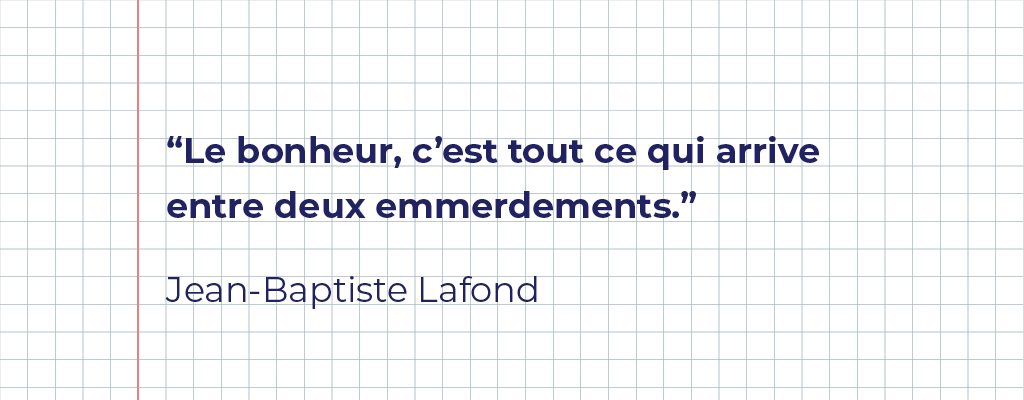
  2. Happiness is everything that happens between two hassles. - Jean-Baptiste Lafond

  3. True happiness costs little: if it’s expensive, it’s not the right type. - François René de Châteaubriand

  4. Happiness is continuing to desire what one possesses. - Saint Augustin

  5. If you want to understand the word happiness, you need to hear it as a reward and a not a goal. - Antoine St-Exupéry

  6. To dream, that’s happiness. To wait, that’s life. - Victor Hugo.

*Happiness | *these words of wisdom

Brave New Word

In researching portmanteau words for a recent blog post, I came across this 2011 article all about another set of words: les néologismes*.

Where a portemanteau is created by the merging of two or more existing words (think ‘brunch' or ‘brainiac’ in English and ‘franglais’ and ‘courriel’ in French), a neologism is a brand new word, freshly invented….and often created by merging two or more existing words. So in theory all portmanteaux started life as neologisms but not all neologisms are portmanteaux, si ça a du sens*...

Interesting to see that the verb ‘textoter' (to text) is still waiting to take off more than ten years after the article’s publication. It must be said, it doesn’t exactly trip off the tongue, though, does it?

Dommage* about ‘watture’ though, 2013’s winner. Created by combining the English word ‘watt’ and the French word for car (voiture), it’s a new word for an electric car. Not only intelligent* but très utile* these days, non*?

Enjoy.

*neologisms | *if that makes sense… | *Shame | *clever | *very useful | *don’t you think?

Portmanteau words

If, upon hearing the word portmanteau, your mind immediately conjures a vintage Louis Vuitton steamer trunk, félicitations*, you know your luxury leather goods brands. And you’re not wrong, either. The hinged trunk that opens out into a travelling wardrobe is indeed called a portmanteau, and possibly hints at its second meaning as well.

A portmanteau is the combination of two words to create a new word with its own meaning. Portmanteau itself is such an example. Porter (meaning to carry or wear) and manteau (meaning coat) come together to give us the word that describes a mobile wardrobe. While in English we call this combination a portmanteau word, in French it’s called a mot-valise, or word suitcase, which makes sense in a complicated way.

We use portmanteau words all the time in English. Some are so ubiquitous we may not recognise them as such: electrocute (electricity + execute), smog (smoke + fog) and fortnight (fourteen + night). Others are more obvious (and amusing) in their origins: affluenza (affluent + influenza), hangry (hungry + angry) and Brangelina (Brad Pitt + Angelina Jolie) spring to mind.

The French have at least as many portmanteaux as we do in English. Below, a short list of our favourites.

*congratulations


A different type of crèche.

Savez-vous que*…

Though we use the word crèche in English to mean a nursery where babies and young children are cared for during the working day, there is another meaning related to Noël*.

Une crèche* is also the French word for a nativity scene, as it comes from the Old French cresche or ‘crib’.

Not up to speed on your French religious figures’ vocab? N’ayez crainte*, we’ve got you covered.

*Did you know that | *Christmas | *a nativity scene | *Never fear

It’s all back to front.

As a child you may have dabbled in a bit of pig latin, but did you know the French have their own secret language called verlan?

The name verlan itself is in fact an illustration of how this very-commonly used langage* works. To create a word in verlan, we must first identify the sounds of the syllables. The next step is to reverse their order. Attention*, you’re not reversing the letters, you’re inverting the sounds of the syllables.

For example, ‘ver-lan’ is made up of the sounds ‘lan-ver’, and l’envers in French means ‘backwards’. Tu piges*?

If not, don’t worry, it’s not immediately obvious, c’est sûr*, so we’ve given you some more examples below.

Interested in this sort of thing? If you live in Brisbane, we’ll be talking more about this little French quirk at our upcoming P’tit Week-end Immersion (more details here).

If you’re busy or don’t live in the area, please enjoy this video instead, by French artist Stromae, whose very name is verlan for Maestro. Clever, non*?

*language | *Be careful | *Do you get it? | *that’s for sure | *isn’t it?

Maman a dit que je peux

Many people struggle to keep the French modal verbs vouloir*, pouvoir* and devoir* straight in their heads.

At Lingua Franca, we teach that:

LCCN_20210910_PVD.png

This charming French publicité* for condoms gives us a much more interesting way to remember the verb pouvoir, though. The little boy’s constant refrain is “Maman a dit que je peux” (Mum said I can), reminding us that pouvoir is as much about permission as it is possibility, and this boy is seemingly granted permission around the clock!

Tellement mignon.*

*to want/wish | *to be able to/can | *to have to/must | *ad | *So cute

La rentrée

You may have heard some talk about la rentrée* earlier this month, as French children were preparing to head back to school.

While la rentrée definitely describes the return to school after the long summer holidays in France, it is also used more broadly among the rest of the population.

In August, virtually the whole of France slows to a crawl, with not only schools but many businesses, restaurants and even the government shutting up shop for the hottest of the summer weather.

Almost everyone takes a holiday away from their home town. The most privileged may eye off international experiences and those on more modest budgets may faire du camping*. Regardless of the destination, le but* is to leave behind le quotidien* for a chance to changer les idées*. It’s for this reason that la rentrée holds such weight in the French culture. Come the start of September, it’s time to pack away the togs, get ready for school or work and look forward to a new year.

Whether that evokes excitement or apprehension probably rests on the quality of les vacances…*

*start of the school year | *go camping | *the aim | *the everyday | *to take one’s mind off something | *the holidays

French animal noises

Savez-vous que*….

Animal noises around the world are not the same? This is just the cutest little video which will have you rethinking the validity of our ‘oink oinks’ and ‘cock-a-doodle-dos’.

See if you’re able to match up the French noises for the various animals below. The first person to contact us with a perfect score will win a Petit Guide de Pronunciation*. Bon courage*!

Cock-a-doodle-do • quack quack • oink oink • coo coo • ribbit ribbit • cheep cheep

LCCN_20210819_Animaux4.png
LCCN_20210819_Animaux2.png
LCCN_20210819_Animaux5.png
LCCN_20210819_Animaux3.png

PS If you’re having difficulty even working out the English, the video is where it’s at!

Lingua Franca Petit Guide de Prononciation

Lingua Franca Petit Guide de Prononciation

*Did you know that | *Little Pronunciation Guide | *Good luck!

Presque amis*

You may have heard of faux amis* in French. These are words that look so similar to English words that they lull you into a false sense of security, having you believe you understand them without even opening your dictionary app. In the past, we’ve told you about blessé (not blessed but hurt), le bras (not a bra but the arm) and les préservatifs (not preservatives but condoms).

But there’s another group of words that may cause you even more trouble because they’re just a bit off. It’s difficult to explain and probably easier to just experience for yourself, so here is a little list for you right below.

*Almost friends

Mika: Elle me dit

Here at Lingua Franca, our students have a variety of learning styles. We try to cater to all styles as much as we possibly can, but there is no replacement for the ideas our students bring to us about their preferred ways of learning.

Recently, one of our students, Nora, was telling her class that she’d found a song that helped her learn the placement of direct and indirect object pronouns. This is an intermediate-level subject, so for you débutants* out there just know that these pronouns are a future pleasure (!) laying in wait for you.

Before I get to Nora’s song, though, which involves a double object pronoun nightmare…pardon* “challenge”, here’s a song that shows the placement of a single object pronoun, in this case, the indirect pronoun me, meaning ‘to me’.

LCCN_20210623_Pronouns.png


The song is called Elle me dit and translates as ‘She says to me’. Literally, it’s ‘She to me says’, as object pronouns are placed between the subject (elle) and the verb (dit) as you’ll hear over and over in this song.

By the way, for les curieux*, here’s a link to the lyrics in both French and English.


Also, look out for a star turn by celebrated French actress Fanny Ardant, who appeared in a blog post last month and whom many of you will know from 2019’s Belle Époque*.

Now here’s Nora’s chanson préférée*, which contains not one, but two, object pronouns. Called Je te le donne, it translates as ‘I give it to you’, or literally ‘I to you it give’. Clair*?

Though the placement and order of double object pronouns can be very complicated, this song gives you an idea of a rule that works for the most part (if you’ve been learning French for even the briefest times, you’ll know it’s not afraid of an exception, like all languages). That rule is this:

Indirect before direct and placed between the subject pronoun and the verb.

LCCN_20210623_Pronouns2.png


PS For those of you who are très, très enthousiastes*, here is the exception:

If both of your object pronouns refer to third person objects, the order is reversed. That is, direct before indirect. For example: Je le lui dis. I say it to him/her. Or literally, I it to him/her say.

*beginners | *sorry | *curious people | *Beautiful Era | *favourite song | *Clear? | *very, very keen

A real name changer

You may know that Snow White is called Blanche Neige in French, but could you name her sept petits amis*?

As a reminder, in English they are: Grumpy, Dopey, Doc, Happy, Bashful, Sneezy and Sleepy.

Can you match the images to the French versions of their names? Bon courage*!

LCCN_20210528_7Dwarves2.png

*seven little friends | Good luck

Funny expressions with avoir

If you’ve studied French for a while, you’ll know that the verb avoir* ranks just behind être* as the language’s most useful verb.

When we’re just starting out, we tend to use avoir to talk about our friends, family and age.

J’ai deux sœurs et un frère.
I have two sisters and a brother.

Je n’ai pas d’enfants
I don’t have any children

J’ai 34 ans.
I am 34 years of age.

So as you can see, though avoir is worth its weight in gold, its application can sometimes seem a little…banal*. With that in mind, we’ve rustled up the following expressions, all of which contain avoir, as well as just a touch more personnalité*

LCCN_20210329_Avoir.png
LCCN_20210329_Avoir3.png
LCCN_20210329_Avoir5.png
LCCN_20210329_Avoir2.png
LCCN_20210329_Avoir4.png
LCCN_20210329_Avoir6.png

*to have | *to be | *pedestrian | *personality

Funny reflexive verbs

Reflexive verbs are rarely fun, but we find using them through colloquialisms makes them a little more intéressants*.

So, what do pelles*, sucettes* and encre* have in common? Not a lot on the face of it, but they do all make an appearance in these strangely funny phrases.

If you can’t remember what reflexive verbs are (or haven’t learned about them yet), they are verbs where the subject and the object are the same, so the action is ‘reflected’. That is, the person doing the action also receives the action.

For example :

Je me lave.

“I wash myself” is reflexive as I’m doing and receiving the washing.

Je lave la voiture.

“I wash the car” isn’t reflexive as I’m doing the washing but not receiving it.

IG_20210210_.png
IG_20210210_2.png
IG_20210210_5.png
IG_20210210_3.png
IG_20210210_4.png
IG_20210210_6.png

*interesting | *shovels | *lollipops | *ink

French Christmas Food

A French Christmas dinner is traditionally shared en famille* on the evening of the 24th December. True traditionalists will have a light supper before attending la messe de minuit*, then return home to the real sit-down dinner, which can last until 4am!

Florence from My Parisian Kitchen, a bilingual French cooking blog, has published her top picks for a traditional feast below, and though times are changing in France as everywhere, a quick straw poll au nid* revealed the team were plus ou moins* in agreement. Bon appétit*!

LCCN_20201219_Noel.png

And let’s not forget le champagne*, of course! As per the My Parisian Kitchen article:

This is not a dish but is actually something you definitely have to serve for a classic French Christmas eve dinner. You may want to pour in crème de cassis blackcurrant liquor to make a Kir Royal. But if the champagne is good, there’s no need!
— Florence (My Parisian Kitchen)

[Read full article]

*with the family | *midnight mass | *the champagne | *at the nest | *more or less | *Happy eating!

Ultimate French Resources #5

I remember doing a translation for a mining company several years ago. The job involved translating an instruction manual for some mining software. Since I wasn’t (and am still not) au fait* with either of these domains, I asked a French friend to help me out.

We met in a café in the city. He’d been in town all day, and didn’t know we were going to meet up. When he arrived, he was carrying a tiny backpack with him. We ordered coffees and got to work.

We struck our first problème* a few minutes in, and I was astonished when he reached down into his backpack and pulled out a battered copy of Le Bescherelle to check a conjugation. The fact that he had prioritised his verb book, along with a bottle of water and his wallet, spoke volumes about the value the French place on this resource. It’s also the reason why you should consider getting one if you’re serious about your French.

71RBpQJUEXL.jpg
81rRmEk3pZL.jpg

WHAT:

A little red book of verb conjugations, given to all French schoolchildren at the age of 10.

POINT FORT*:

The design. It has the conjugations for over 12 000 French verbs, yet the book is compact and slimline. The secret? All 12 000 verbs are divided into categories according to how they are conjugated and then one very common verb from each group is chosen to be conjugated in full. That is, it is conjugated for all ‘persons’ (je, tu, il, elle, etc.) and in all tenses (don’t freak out when you see them all - there are a lot). The rest are found in the index along with the category number for easy reference.

POINT FAIBLE*:

It takes a little while to work out how to use it and it’s easy to mix up the page number and category number (see above). Once you’ve got the hang of it, though, you’ll wonder how you ever did without it. I know there are fantastic apps for French verbs on the market and I use one myself, but there’s something about the seriousness and accuracy of Le Bescherelle that I really enjoy. Plus, being able to look at all the tenses at once without having to move a screen around is a relief, franchement*.

PS:

There’s also a Bescherelle for very young children called Mon Premier Bescherelle Illustré* which is absolutely beautiful as well as a great way to improve your vocabulary!

 
Mon premier Bescherelle illustré.jpg
 

*knowledgeable | *problem | *pro | *con | *frankly | *My First Illustrated Bescherelle