Lingua Franca | Award-Winning French Lessons Brisbane

French lessons, events & trips

FRENCH LESSONS EVENTS & GIFTS

Filtering by Category: Learn French

La Petite Histoire

If you've ever done a group lesson here at Lingua Franca, you've probably come into contact with La Petite Histoire*. A tale with the very humblest of beginnings, it winds up becoming a rollicking schlockbuster as you move up the levels and your French improves enough to handle the outrageous (some would say impossible) turns of events of the six young friends.

La Petite Histoire is currently only available to our students, however La Préquelle is for everyone’s enjoyment. Below, another instalment of this new series, Chapter 2 of the Intermediate 2 level.

*The Little Story | *The Prequel

“Tu m’écoutes, Léïla ?”

“Pardon ? Qu’est-ce que tu as dit ?” j’ai répondu à mon frère, Hervé, qui me regardait attentivement.

“Ça va ? Qu’est ce qu’il y a, Léïla ? Tu as l’air…je ne sais pas…un peu triste ? Tout va bien ?”

“Oh je suis désolée, Hervé. Je pensais à quelque chose.”

Il faisait un peu froid mais beau aujourd’hui donc mon frère et moi avons décidé de se retrouver sur le Pont du Carrousel près du Louvre pour faire une promenade avec mes enfants. Les enfants d’Hervé étaient à la maison avec sa femme, Amina. Les jumelles étaient en poussette et Anouk marchait toute seule, très lentement. Elle avait trois ans et elle adorait son oncle.

“Tonton, tonton, regarde !” elle a dit. “Il y a un château !”

“Tu as raison, mon lapin, dans le passé c’était un château, mais maintenant c’est un musée.”

“Un grand musée, “ elle a ajouté. “Avec beaucoup de dessins.”

“Elle a ton intelligence, c’est sûr,” Hervé a dit, et il a pris mon bras. “Bon, qu’est-ce qu’il y a, ma petite sœur ? Dis-moi tout.”

“Oh, ce n’est rien. Vraiment, rien de grave. Je suis juste un peu fatiguée, c’est tout.”

“Tu es sûre ? C’est les enfants ? Mais ce sont des anges !” il m’a taquiné. Hervé connaissait très bien ses nièces et il comprenait que même si elles étaient adorables, elles étaient aussi parfois difficiles. Particulièrement les jumelles, qui ne dormaient pas beaucoup.

“Oui, les enfants, et mes études, et…” Je n’ai pas fini ma phrase.

“Et ? Et quoi ? C’est Jean-Louis ? Vous avez des problèmes ?” Hervé avait l’air concerné. Je n’aimais pas quand mon frère me regardait comme ça.

“Non, ça va, honnêtement. Je suis simplement fatiguée et un peu stressée. Ce n’est pas grave. Je te promets. Bon, pardon, qu’est-ce que tu disais à l’instant ?”

“Je disais qu’Amina et moi allons partir pour Londres dans deux semaines pour aller voir nos amis, Robert et Beth. Tu te rappelles de Robert et Beth ? Ils habitent à Bath.”

“Ah oui, bien sûr! Amina a fait un échange au lycée et elle est restée avec Robert et Beth et leurs fils. Comment il s’appelle déjà ?”

“Michael. Oui, on y va pour quelques jours. Les enfants vont rester avec Maman. Tu dois venir avec nous ! J’ai l’impression que tu as besoin de changer les idées un peu, non ? Et tu peux pratiquer ton anglais.”

“Non, je veux dire, oui, mais non, je ne vais pas venir avec vous deux ! Vous devez profiter de partir en vacances sans les enfants. C’est comme une deuxième lune de miel.”

Hervé a commencé à dire quelque chose quand on a entendu une petite voix derriere nous dire: “Les crêpes au miel, oui, s’il te plaît, Maman ! J’adore !” 

Hervé et moi s’est regardé et on a commencé à rigoler.


“Are you listening to me, Léïla ?”

“Sorry? What did you say?” I replied to my brother, who was looking at me attentively.

“Are you okay? What’s up, Léïla? You seem…I don’t know…a bit sad? Is everything okay?”

“Oh, I’m sorry, Hervé. I was thinking about something.”

It was a bit cold but fine today so my brother and I decided to meet each other on the Pont du Carrousel near the Louvre to go for a walk with my children. Hervé’s children were at home with his wife, Amina. The twins were in the pusher and Anouk was walking all by herself, very slowly. She was three years old and she adored her uncle.

“Uncle, uncle, look!” she said. “There’s a big castle over there!”

“You’re right, my little rabbit, in the past it was a castle, but now it’s a museum.”

“A big museum,” she added. “With lots of drawings.”

“She has your intelligence, that’s for sure,” Hervé said, and he took my arm. “Right, what’s wrong, little sis? Tell me everything.”

“Oh, it’s nothing. Really, nothing serious. I’m just a bit tired, that’s all.”

“Are you sure? It is the kids? But they’re angels!” he teased me. Hervé knew his nieces very well and he understood that even if they were adorable, they were also difficult at times. Particularly the twins, who didn’t sleep a lot.

“Yes, the kids, and my studies, and…” I didn’t finish my sentence.

“And? And what? Is it Jean-Louis? Are you having problems?” Hervé seemed concerned. I didn’t like it when my brother looked at me like that.

“No, it’s fine, honestly. I am simply tired and a bit stressed. It’s not serious. I promise. Right, sorry, what were you saying just now?”

“I was saying that Amina and I are going to leave for London in two weeks to go and see our friends, Robert and Beth. Do you remember Robert and Beth? They live in Bath.”

“Oh yes, of course! Amina did an exchange at high school and she stayed with Robert and Beth and their son. What is his name again?”

“Michael. Yes, we’re going for a few days. The kids are going to stay with Mum. You have to come with us! I get the feeling you need a bit of a change of scenery, don’t you? And you can practise your English.”

“No, I mean, yes, but no, I am not going to come with you two! You have to make the most of going on holidays with the kids. It’s like a second honeymoon!”

Hervé started to to say something when we heard a little voice behind us say”

“Crêpes with honey, yes please, Mum! I love them!”

Hervé and I looked at each other and started to laugh.

La Petite Histoire

If you've ever done a group lesson here at Lingua Franca, you've probably come into contact with La Petite Histoire*. A tale with the very humblest of beginnings, it winds up becoming a rollicking schlockbuster as you move up the levels and your French improves enough to handle the outrageous (some would say impossible) turns of events of the six young friends.

La Petite Histoire is currently only available to our students, however La Préquelle is for everyone’s enjoyment. Below, another instalment of this new series, Chapter 1 of the Intermediate 2 level.

*The Little Story | *The Prequel

“Coucou !” j’ai crié quand j’ai ouvert la porte de notre appartement. “C’est moi !”

Silence.

“Jean-Louis ?” j’ai appelé. “Tu es là ?”

Rien. J’ai mis mon manteau sur notre lit et je suis entrée dans le salon. Personne. La salle était tout sombre.

“Il est quelle heure ?” Jean-Louis a demandé.

“Oh là, là !” j’ai crié. “Jean-Louis, tu m’as fait peur ! Pourquoi tu n’as pas mis la lumière ? Tu es malade ?”

“Non, je ne suis pas malade, Leïla. Je suis triste. Il y a une différence,” il a répondu.

“Ah, mon chéri ! Qu’est-ce qu’il y a ? Tu as de mauvaises nouvelles du Maroc ? Je suis désolée. Qu’est-ce que je peux faire ?” j’ai demandé.

Jean-Louis n’a rien dit pour quelques secondes. Il avait l’air un peu étrange.

“Qu’est-ce que tu peux faire, Leïla. Hmm, voyons, c’est une très bonne question. Bon, pour commencer, tu peux te comporter comme ma femme, pas comme une adolescente,” il a dit. Il était furieux.

“Quoi ?” j’ai répondu. J’étais dévastée. J’adorais mon mari alors pourquoi il me parlait comme ça?

“Tu as entendu,” il a dit.

“Mais Jean-Louis, quel est le problème ? Je suis allée à l’université, j’ai pris un verre avec une amie et puis je suis rentrée. Pourquoi tu es agité ?”

“Une amie ?” il a répondu. “Tu es sûre que ce n’était pas ‘un ami’, Leïla ?”

Je ne pouvais pas respirer. Je ne savais pas quoi dire. J’adore Jean-Louis, mais il est jaloux parfois.

“Non, une amie. Une amie que tu connais, en fait, Jean-Louis. Noëlle.”

“Ha ! Noëlle ? Tu penses que c’est une amie, Leïla ? Cette femme est une grande manipulatrice et tu es trop naïve de comprendre ça.”

“Moi, naïve ? Tu plaisantes. C’est toi qui a une petite vie. Tu travailles, tu rentres, et tu voyages une fois par an pour voir tes parents. Pour moi, c’est toi qui souffre de la naïveté.”

Avec ça, Jean-Louis s’est levé, et il s’est approché de moi.

“Et en plus, tu pues ! Ton parfum c’est du vin, aujourd’hui, ma femme. J’ai honte pour toi ! Tu es une mère !”

“Oui, ça c’est correcte, Jean-Louis, je suis une mère, mais tu n’es pas mon père ! Arrête de parler comme ça !”

Jean-Louis a pris mon bras avec beaucoup de force.

“Ne me touche pas, Jean-Louis. Je te promets, je te quitte.” C’était moi maintenant qui était furieuse. J’ai quitté le salon et j’ai claqué la porte derrière moi. Et puis, j’ai commencé à pleurer.


“Hi there!” I shouted as I opened the door to our apartment. “It’s me!”

Silence.

“Jean-Louis?” I called. “Are you there?”
Nothing. I put my coat on our bed and entered the living room. No-one. The room was all dark.

“What time is it?” Jean-Louis asked.

“Oh my goodness!” I cried. “You scared me! Why haven’t you turned on the light? Are you unwell?”

“No, I am not sick, Leïla. I am sad. There is a difference,” he responded.

“Oh, my darling, what’s wrong? Did you get some bad news from Morocco? I am sorry, what can I do?” I asked. Jean-Louis didn’t say anything for a few seconds. He seemed a bit strange.

“What can you do, Leïla? Hmm, let’s see, that’s a good question. Well, to start with, you could behave as my wife, not as a teenager,” he said. He was furious.

“What?” I replied. I was devastated. I adored my husband so why was he speaking to me like that?

“You heard,” he said.

“But Jean-Louis, what is the problem? I went to university, I had a drink with a friend and then I came home. Why are you agitated?”

“A female friend?” he responded. “Are you sure it wasn’t a ‘male friend’, Leïla?”

I couldn’t breathe. I didn’t know what to say. I adore Jean-Louis, but sometimes he gets jealous.

“No, a female friend. A female friend that you know, in fact. Noëlle.”

“Ha! Noëlle? Do you think she’s a friend, Leïla? That woman is a huge manipulator and you’re too naive to understand that.”

“Me, naive? You are joking. It’s you that has a little life. You work, you come home, and you go once a year to Morocco to see your parents. For me, it’s you who is suffering from naivety.”

With that, Jean-Louis got up, and made his way over to me. “And what’s more, you stink! Your perfume is wine today, my wife. I am ashamed for you. You are a mother!”

“Yes, that’s correct, Jean-Louis, I am a mother, but you are not my father. Stop speaking like that!”

Jean-Louis grabbed hold of my arm really hard.

“Do not touch me, Jean-Louis. I promise you, I’ll leave you.” It was me now who was furious. I left the living room and slammed the door behind me. And then, I started to cry.

It gets easier

I was doing a lesson with one of our very long-term students a few weeks ago, looking at all of the French verb tenses (there are 15 conservatively, more like 19 or 20 when you go deep). 

If you’ve not immediately smashed your computer screen and headed to the nearest corner for a soothing rock, stay with me, because this is a happy news story (je te jure* !).

In looking at all the tenses, we realised that beyond a certain point, they mostly become compounds of the ones you already know (and those that don’t are likely to be literary tenses and very rarely used).

For example, the futur proche* is really just a combination of the present tense plus the infinitive (je vais parler - I am going to speak). For those of you who have dug a little further back into the French grammar armoire*, you’ll know that the plus-que-parfait* is just an amalgam of the imperfect tense and the past participle that you’ve already seen in the passé composé* (j’avais parlé - I had spoken).

It goes on. The futur antérieur* is a combo of the futur simple* and the past participle (j’aurai parlé - I will have spoken) and the past conditional just takes it a step further (j’aurais parlé - I would have spoken).

So, it’s a bit like an apprenticeship, or apprentissage. You have to do the hard yards first in order to develop the skills that will allow you to master your chosen trade in the future.

This may not be sounding like a good news story yet, granted. It might just sound like plain old hard work, which it sometimes is (even though there are many moments of delight along the way).

But the good news starts here. 

Much like my Mum’s very sage advice to me the first time I had my heart broken (“It will never be this hard again, I promise”), your very first course will always be the most testing.

At Lingua Franca we have 16 different levels ranging from Absolute Beginner 1 to Advanced Revision. By far and away the first lesson of Absolute Beginner 1 is the trickiest. In fact, to be more specific, it’s the very first vocabulary list, about some seemingly benign basic greetings, that can cause intellectual panic to set it.

Take a look for yourself:

In that very first 15 minutes of the lesson, we touch on the following:

  • silent letters

  • strange vowel combinations (oi is pronounced wuh?)

  • tu vs vous

  • the supremacy of the masculine gender (in grammatical terms)

  • standard vs familiar language (bonjour vs salut)

  • liaison

  • the difference between on and nous

  • pronunciation exceptions (monsieur)

  • how to pronounce French ‘r’s

  • agreement (enchanté vs enchantée)

C’est beaucoup, non*? If you’ve been doing French for a little while, the above list probably doesn’t look that scary at all. You’ve may have even forgotten that these were new concepts to you once upon a time. But imagine how it feels to be back there at Lesson 1, trying to take all of this in. You’d think it was a foreign language.

Spare a thought for our Absolute Beginner 1 students, as it doesn’t let up for the rest of the workbook. Numbers to 100 (“what do you mean 4 x 20 means 80?”), nationalities without capital letters, the joy of their first irregular verb (hello, être*) and the back-to-frontness (for English-speakers) of the noun plus adjective situation. 

We can actually pinpoint the moment the shine will come off for most brand new students. It’s Lesson 4, when they learn to conjugate (huh?) their very first regular verb. The mood almost always goes from engaged and excited to focused and serious as they broach the verb vendre* and when the door opens at the end of the lesson, it’s like a wave of tension follows the students out. 

However, for the courageux* and courageuses* who front up for Lesson 5, it’s all good news. Having had their French hearts broken, it’s only upwards and onwards from that point. Places around town (fun!). A guessing game in French? Count me in!

And so it goes along the winding path of your French learning. Peaks and valleys, climbs, descents and periods of coasting.

Another of our students tells a very reassuring story of learning to be a volunteer guide at an art gallery. The training was extensive and the information new and copious. With so much information swimming around in their heads, the trainees felt as though they’d never be able to remember everything, let alone communicate it in a comprehensible (and engaging) way. 

Just when our student thought she could take no more, the trainer explained to her that it was totally natural at that point to be utterly confused.

The trainer explained to them that this period of confusion often represented the last moments before the information would start to synthesise and arrange itself in their heads. That is, that this was the worst it would get. As it turns out not only was Mum a master consoler, but she had some insight into brain function as well.

It might help to think of your learning as a series of waves of various heights, with blobs of confusion dotted along the way. Comme ça*, the next time you’re faced with a new and challenging concept, you can be secure in the knowledge that understanding and mastery is just over the next rise, and that, de toute façon* you’ve seen much worse before.

*I promise | *close future | *cupboard | *pluperfect | *past perfect tense | *future perfect | *future simple tense | *It’s a lot, isn’t it? | *to be | *to sell | *courageous (male) people | *courageous (female) people | *That way | *In any case

Actus français facile

Our first steps into listening to French can be slightly harrowing. My mind goes to preparing DELF students for their exams by listening to authentic audio tracks. Until I hit play, they have no idea what they’ll be faced with: are they in a train station, at the supermarket, is it a debate or simply a couple talking about upcoming holiday plans?

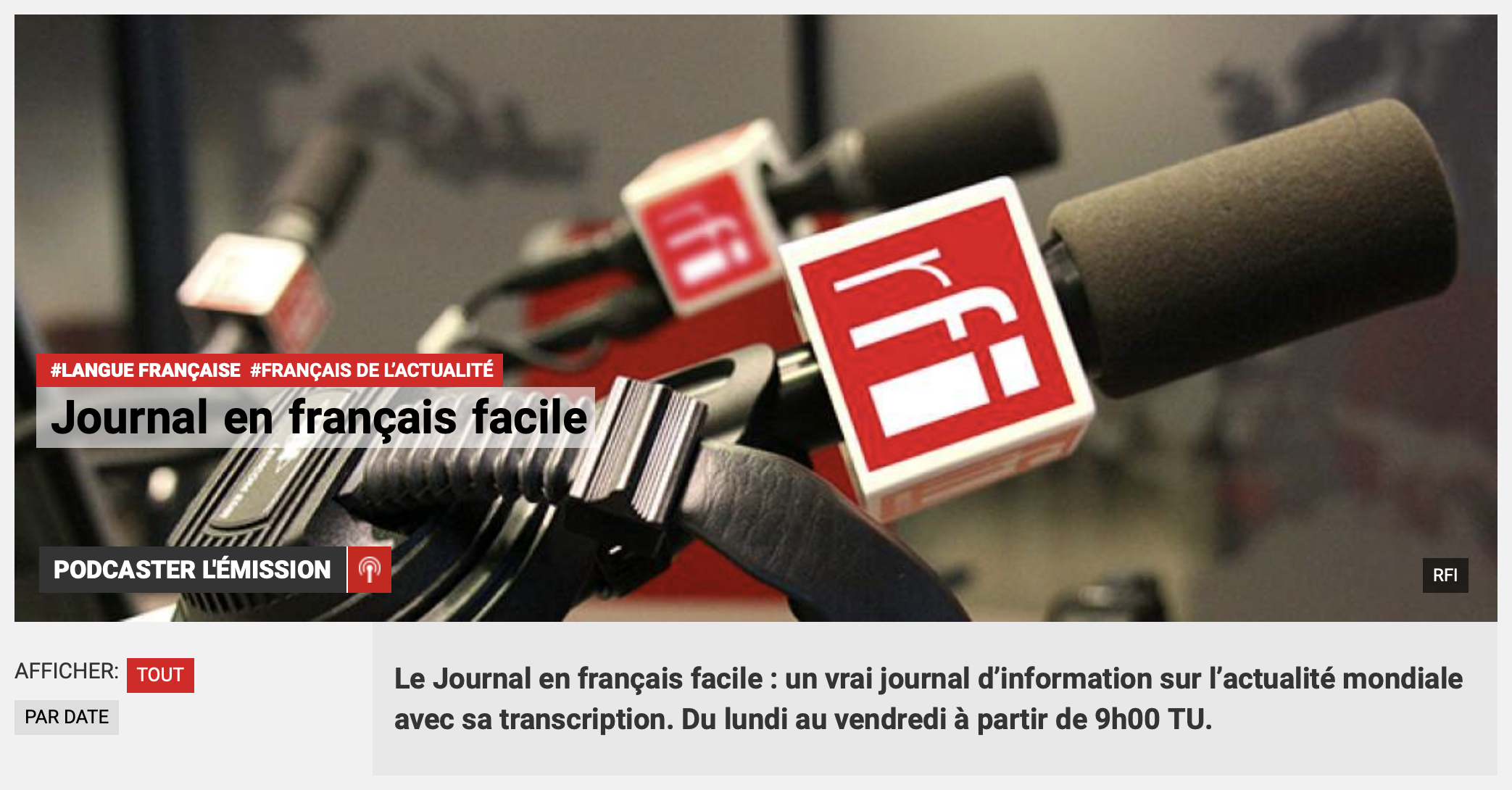
A lack of context can be a true impediment to comprehension which is why I really love Radio France Internationale’s Journal en français facile*. The subject matter is international current affairs, giving us at least some immediate context.

The language has been pared back and slowed down for a global audience, and there’s also a full transcript you can use to follow along. If you’re really keen, you could even read the dialogue ahead of time to translate any unknown vocabulary before your first listen. If you’re short on time, though, I still recommend just popping it on in the background (if only for the opening news theme which makes me feel like I’m right back in France).


*News in easy French

La Petite Histoire

If you've ever done a group lesson here at Lingua Franca, you've probably come into contact with La Petite Histoire*. A tale with the very humblest of beginnings, it winds up becoming a rollicking schlockbuster as you move up the levels and your French improves enough to handle the outrageous (some would say impossible) turns of events of the six young friends.

La Petite Histoire is currently only available to our students, however La Préquelle is for everyone’s enjoyment. Below, another instalment of this new series, chapter 6 of the Intermediate 1 level.

*The Little Story | *The Prequel

“Bonsoir Simon, comment allez-vous ?” j’ai demandé alors que mon professeur s’installait à notre table de café.

“Très bien, merci Leïla, et vous ?” il a répondu poliment.

“Simon, je vous présente mon amie, Noëlle. Noëlle, c’est Simon, mon professeur d’anglais,” j’ai dit.

“Enchantée, Simon,” Noëlle a dit et elle a sourit. “Vous voulez boire quelque chose ?”

“Oui, avec plaisir, mais c’est moi qui vous invite,” a répondu Simon. “Que voulez-vous boire ?”

“Ah, un vrai gentleman anglais, je vois,” Noëlle a dit gaiement. “Quelle plaisir de vous rencontrer, Simon.” 

“Vous aussi, Noëlle. Alors, mesdames, vous voulez du café ou autre chose?” il a demandé.

“Un petit café pour moi, s’il vous plaît, Simon,” j’ai dit. “Merci, c’est gentil.”

“Toujours très sage, notre Leïla,” Noëlle a taquiné. “Vous ne trouvez pas, Simon ? Elle doit être la chouchoute de votre classe, non ? Vous ne préférez pas un autre vin, Leïla ?”

“Non, je ne peux pas, je suis désolée. Je vais devoir partir bientôt et on a déjà pris deux verres. Ça suffit pour moi.”

Noëlle a levé les yeux au ciel et a dit: “Simon, un autre vin rosé pour moi, s’il vous plaît. Ou prenons une bouteille ?”

Simon a fait signe au serveur “S’il vous plaît !”. Le serveur est venu tout de suite. “Un café et un pitcher de vin rosé avec deux verres, s’il vous plaît. Et les toilettes sont en bas ?” il a demandé.

“Oui, monsieur,” il a répondu. “Juste derrière le bar.”

“Simon, quand vous allez aux toilettes, est-ce que ça vous dérange si on change de chaises ? Je voudrais bien profiter des dernières minutes de soleil,” Noëlle a dit.

“Bien sûr, Noëlle,” Simon a dit. C’est vrai, c’est un gentleman, Simon.

“Merci beaucoup,” Noëlle a dit et elle s’est levée pour changer de chaises. Elle portait une mini-jupe rayée avec de longues bottes blanches. Elle regardait Simon et elle a dit: “Une autre raison pour apprécier les Anglais - les mini-jupes. Mary Quant est anglaise, n’est-ce pas, Simon ? J’adore porter les mini-jupes. Je me sens tellement libérée !”

Simon a rougi un petit peu et il s’est excusé pour aller aux toilettes.

“Noëlle,” j’ai dit. “Arrête ! Tu as vu son visage? Simon est timide, ne fais pas ça avec lui. C’est mon prof !”

“Ah, Leïla, calme-toi. C’est un adulte, et de toute façon, c’est une blague ! Oh là, là, parfois je ne comprends pas pourquoi on est amies. Tu es tellement sérieuse. En plus, il est tellement beau, je ne peux pas résister !"

“Good evening, Simon, how are you going?” I asked as my teacher took a seat at our café table.

“Very well, thanks Leïla, and you?” he responded politely.

“Simon, I’d like you to meet my friend, Noëlle. Noëlle, this is Simon, my English professor,” I said.

“Pleased to meet you, Simon,” Noëlle and she smiled. “Do you want something to drink?”

”Yes, with pleasure, but please allow me,” responded Simon. “What do you want to drink?”

“Oh, a true English gentleman, I see,” Noëlle said gaily. “What a pleasure to meet you, Simon.”

“You too, Noëlle. So, ladies, do you want coffee or something else?” he asked.

“A coffee for me, please, Simon,” I said. “Thank you, that’s nice of you.”

“Always so good, our Leïla,” Noëlle teased. “Don’t you think, Simon? She must be the teacher’s pet of the class, no? You wouldn’t rather another wine, Leïla?”

“No, I can’t, I’m sorry. I am going to have to leave soon on we’ve already had two glasses. That’s enough for me.”

Noëlle rolled her eyes and said: “Simon, another rosé for me, please. Or shall we have a bottle?”

“Excuse me!” Simon called the waiter over, who came straight away. “A coffee and a pitcher of rosé with two glasses, please. And are the toilets downstairs?” he asked.

“Yes, sir,” he responded. “Just behind the bar.”

“Simon, when you go to the toilet, so you mind if we change chairs? I’d like to make the most of the last few minutes of sun,” Noëlle said.

”Of course, Noëlle,” Simon said. It’s true, he’s a gentleman, Simon.

“Thank you very much,” Noëlle said and got up to change chairs. She was wearing a striped mini-skirt and long white boots. She was looking at Simon when she said: “Another reason to like the English - mini-skirts! Mary Quant is English, isn’t she, Simon? I love wearing mini-skirts. I feel so free!”

Simon blushed a little and excused himself to go the the toilet.

“Noëlle,” I said. “Stop! Did you see his face? Simon’s shy, don’t do that with him. He’s my professor!”

“Oh Leïla, calm down. He’s an adult, and anyway, it’s a joke! Gee, sometimes I don’t know how we’re friends. You’re so serious. Plus, he’s so handsome, I can’t resist!”

Why learn a language?

If you’re reading this blog, it’s likely you have your own answer to this question, but sometimes, when you’re knee-deep in the bizarreries* of the verb être*, it can be hard to remember why on earth you started in the first place.

A gently motivational response to the question by world-renowned linguist John McWhorter.

*quirks | *to be

A quest for happiness

Le bonheur* is both a beautiful French word and a noble pursuit, one which French philosophers and writers have pondered for centuries.

Grab a coffee and take the time to reflect sur ces bonnes paroles*.

  1. I recognised my happiness by the sound it made in leaving. - Jacques Prévert

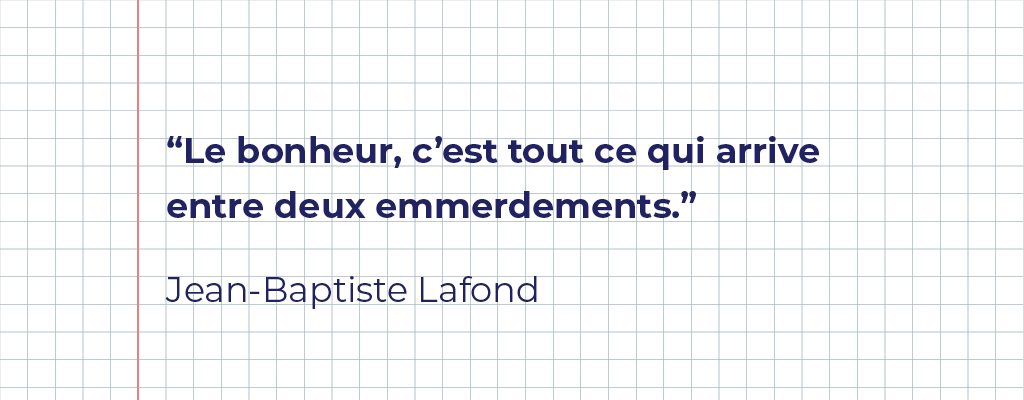
  2. Happiness is everything that happens between two hassles. - Jean-Baptiste Lafond

  3. True happiness costs little: if it’s expensive, it’s not the right type. - François René de Châteaubriand

  4. Happiness is continuing to desire what one possesses. - Saint Augustin

  5. If you want to understand the word happiness, you need to hear it as a reward and a not a goal. - Antoine St-Exupéry

  6. To dream, that’s happiness. To wait, that’s life. - Victor Hugo.

*Happiness | *these words of wisdom

La Petite Histoire

If you've ever done a group lesson here at Lingua Franca, you've probably come into contact with La Petite Histoire*. A tale with the very humblest of beginnings, it winds up becoming a rollicking schlockbuster as you move up the levels and your French improves enough to handle the outrageous (some would say impossible) turns of events of the six young friends.

La Petite Histoire is currently only available to our students, however La Préquelle is for everyone’s enjoyment. Below, another instalment of this new series, chapter 5 of the Intermediate 1 level.

*The Little Story | *The Prequel

Deux jours plus tard, je prenais un verre avec Noëlle après notre leçon dans un petit café près de la Sorbonne. Il faisait beau et nous étions dehors pour profiter du soleil.

“Ah, j’adore Paris,” a dit Noëlle. “Cette ville est vraiment spéciale. Sydney est une belle ville aussi, bien sûr, et la baie et les plages sont magnifiques, mais Paris a une beauté qui est difficile de surpasser.”

“Tu te sens vraiment à l’aise ici, alors, Noëlle ?” j’ai demandé.

“En fait, c’est plus que ca, Leïla. C’est chez moi. Je me sens très bien dans ma peau ici. J’adore l’Australie, mais franchement, vivre en Europe me va très bien. J’ai très envie de rester ici.”

“Oui, Jean-Louis a dit que tu parlais de ça quand tu étais chez nous l’autre jour. Il a dit que tu vas essayer de trouver un travail ici pour pouvoir rester. C’est vrai ?”

“Oui, tout à fait. Un travail…ou un homme. Peu importe !” elle a exclamé.

“Mais comment ça, un homme ?” j’ai demandé, confuse.

“Ben, comme je disais à Jean-Louis, c’est une question de visa. Je peux avoir un visa pour rester ici grâce à un travail, ou grâce à un homme. Un homme français, bien sûr,” elle a ajouté et elle a souri. “Tu veux un autre vin rosé, Leïla ?”

“Ah, oui, pourquoi pas? Jean-Louis est à la maison avec les enfants ce soir. Je ne dois pas rentrer tout de suite.”

“Mais tu dois rentrer pour préparer son dîner, non ?” Noëlle me taquinait…je crois.

“Il n’est pas comme ça, Noëlle. C’est juste qu’il ne sait pas cuisiner, donc c’est plus facile si je prépare le dîner.”

“Mais c’est 1968, Leïla, pas 1938. Le monde a changé !”

Je voulais dire quelque chose, mais j’ai remarqué que Noëlle ne me regardait plus. Elle regardait Simon, mon professeur d’anglais qui traversait la rue.

“C’est ton prof, Noëlle ? Comment il s’appelle ?”

“Simon, mais - ” j’ai commencé à dire, mais c’était trop tard.

“Ooh, il est beau ! Simon ! Par ici ! Venez nous joindre !”

Et juste comme ça, ma vie est devenue un peu plus compliquée.

Two days later, I was having a drink with Noëlle after our lesson at a little café near the Sorbonne. It was nice weather et we were outside to make the most of the sun.

"Oh, I love Paris," said Noëlle. "This city is truly special. Sydney is a beautiful city as well, of course, and the harbour and the beaches are magnificent, but Paris has a beauty that is hard to beat."

"You feel really at ease here, then, Noëlle?" I asked.

"In fact, it's more than that, Leïla. This is my home. I fell really comfortable in my skin here. I adore Australia, but frankly, living in Europe suits me very well. I really want to stay here.”

“Yes, Jean-Louis said that you were talking about that when you were at our place the other day. He said that you are going to try to find a job here in order to be able to stay. Is that true?”

“Yes, absolutely. A job…or a man. Doesn’t matter!” she exclaimed.

“What do you mean, a man?” I asked, confused.

“Well, as I was saying to Jean-Louis, it’s a matter of a visa. I can have a visa to stay here thanks to a job, or thanks to a man. A French man, of course,” she added and she smiled. “Do you want another rosé, Leïla?”

“Oh, yes, why not? Jean-Louis is at home with the children tonight. I don’t have to go home straight away.”

“But you have to go home to make his dinner, don’t you?” Noëlle was teasing me…I think.

“He’s not like that, Noëlle. It’s just that he doesn’t know how to cook, so it’s easier if I prepare the dinner.”

“But it’s 1968, Leïla, not 1928. The world has changed!”

I wanted to say something, but I noticed that Noëlle was no longer looking at me. She was looking at Simon, my English professor, who was crossing the road.

“It that your teacher, Noëlle? What’s his name?”

“Simon, but - ” I started to say, but it was too late.

“Ooh, he’s handsome ! Simon ! Over here! Come and join us!”

And just like that, my life became a little more complicated.

La Petite Histoire

If you've ever done a group lesson here at Lingua Franca, you've probably come into contact with La Petite Histoire*. A tale with the very humblest of beginnings, it winds up becoming a rollicking schlockbuster as you move up the levels and your French improves enough to handle the outrageous (some would say impossible) turns of events of the six young friends.

La Petite Histoire is currently only available to our students, however La Préquelle is for everyone’s enjoyment. Below, another instalment of this new series, chapter 4 of the Intermediate 1 level.

*The Little Story | *The Prequel

Je me suis levée pour aller dans la cuisine et j’ai commencé à préparer le café. Je pouvais entendre mon mari, Jean-Louis, et mon amie, Noëlle, qui parlaient.

”Donc, vous disiez que vous voulez rester ici à Paris après vos études, Noëlle. En fait, ça vous dérange si on se dit ‘tu’?” a demandé Jean-Louis.

”Avec plaisir,” a répondu Noëlle. “Je sais qu’on ne se connaît pas très bien, mais Leïla parle de vous…oups, pardon, de toi beaucoup, donc j’ai l’impression de te connaître bien déjà.”

”Toi, aussi, Noëlle. Donc, tu penses pouvoir trouver un travail à la fin de tes études?”

”Normalement, oui, Jean-Louis. La Sorbonne est une excellente université, comme vous savez, et d’habitude, il y a beaucoup de demande pour les professeurs. Mais, avec la situation en ce moment, ça ne va pas être facile.”

”Comment ça?” a demandé Jean-Louis, “Quel est le problème?”

”Ben, l’économie ne va pas très bien, et par conséquent, il n’y a pas beaucoup de travail. Les étudiants ont peur de ne pas pouvoir trouver un travail après leurs études,” a expliqué Noëlle.

”Oui, mais tout le monde sait que les étudiants sont paresseux, Noëlle. S’ils veulent vraiment travailler, ils peuvent trouver un poste.”

J’étais toujours dans la cuisine quand j’ai entendu ça et quand je suis retournée dans la salle à manger avec le café, Noëlle avait l’air fâché.

”Ce n’est pas comme ça, Jean-Louis,” j’ai dit. “Il y a un vrai problème en ce moment et de Gaulle et ses ministres ne font rien ! Il y a même des problèmes au campus de Nanterre. Je connais des étudiants là-bas et ils ne sont pas contents.”

”Les étudiants ne sont jamais contents !” a crié Jean-Louis. “Ils critiquent tout, tout le temps ! C’est ridicule !”

”J’hésite à te dire, Jean-Louis, mais ils commencent à faire plus que critiquer. Ils s’organisent, et ils vont commencer à faire des manifestations très bientôt. Je suis d’accord avec eux. Moi aussi, je vais manifester,” Noëlle a dit avec beaucoup de passion.

”Moi au -", j’ai commencé, mais dans le même instant, Jean-Louis a décidé de parler.

”Ben, je peux te dire, Noëlle, que Leïla ne va pas faire ça, ça c’est sûr. Pas ma femme !

”J’ai rougi, j’ai baissé la tête et j’ai servi le café.

I got up to go into the kitchen and I started to prepare the coffee. I was able to hear my husband, Jean-Louis, et my friend, Noëlle, who were speaking.

“So, you were saying that you think you want to stay here is Paris after your studies, Noëlle. In fact, does it bother you if we call each other ‘tu’?” asked Jean-Louis.

“With pleasure,” responded Noëlle. “I know that we don’t know one another very well, but Leïla speaks about you…oops, sorry, you a lot, so I have the impression of already knowing you well.”

“You, too, Noëlle. So, you think you’ll be able to find a job at the end of your studies?”

“In theory, yes, Jean-Louis. The Sorbonne is an excellent university as you well know, and usually, there is a lot of demand for teachers. But, with the situation at the moment, it’s not going to be easy.”

“In what way?” asked Jean-Louis. “What’s the problem?”

“Well, the economy isn’t going very well, and as a consequence, there isn’t a lot of work. Students are scared about not being able to find a job after their studies,” explained Noëlle.

“Yes, but everyone knows students are lazy, Noëlle. If they really want to work, they can find a position.”

I was still in the kitchen when I heard that and when I returned to the dining room with the coffee, Noëlle seemed angry.

“It’s not like that, Jean-Louis,” I said. “There is a real problem at the moment and de Gaulle and his ministers are doing nothing! There are problems at the Nanterre campus. I know some students there and they’re not happy.”

“Students are never happy?” cried Jean-Louis. “They criticise everything, all the time! It’s ridiculous!”

“I hesitate to tell you, Jean-Louis, but they’re starting to do more than criticise. They are getting organised, and they’re going to start protesting very soon. I agree with them. I’m going to protest as well,” Noëlle said with a lot of passion.

“Me t - ,” I started, but at the same time, Jean-Louis decided to speak.

“Well, I can tell you, Noëlle, that Leïla is not going to do that. Not my wife!”

I blushed, lowered my head and I served the coffee.

Madeleine de Proust

Talk turned to madeleines* this week at Lingua Franca, which in and of itself, is not a rare occurrence.

However, for once we weren’t rhapsodising about their buttery delights, rather the talk was of les souvenirs* and what provokes them. Pourquoi*?

Because Marcel Proust, a privileged but poorly French writer, who was confined to his bed for much of his life, wrote of an événement déclencheur* in the first volume of his classic text À la Recherche du Temps Perdu*. That event was being handed a madeleine and une tasse de thé* by his mother as he was convalescing, and the taste of that delicious madeleine immediately transported him back to his childhood, when his Tante Léonie* would offer him a taste of hers after she’d dipped it in her lime-flower tea.

With the work spanning seven volumes and containing more than a million words, Proust is not known for his vitesse*. In fact, the madeleine incident occurs only on page 95, so it’s fair to say he’s not a man in a hurry. Nonetheless, the scene is widely recognised as the point where the book really takes off, as detailed in this excellent article from the Penguin website.

Proust had his fans (Virginia Woolf, Grahame Greene, Victor Nabakov) as well as his his detractors (Somerset Maugham, Kazuo Ishiguro) but it’s unlikely any of them would turn down a petite madeleine* if offered by a caring and affectionate aunt.

If all this talk of les pâtisseries* has served to réveiller vos papilles*, voici la recette* again.

Un grand merci à Kathryn* who brought this delightful sujet* to the table at her class on Wednesday night.

*a traditional small cake from the Lorraine region | *memories | *Why? | *trigger event | *In Search of Lost Time | *a cup of tea | *Aunt Léonie | *speed | *little madeleine | *pastries | *wake up your tastebuds | *here is the recipe | *A big thank you to Kathryn | *subject

Brave New Word

In researching portmanteau words for a recent blog post, I came across this 2011 article all about another set of words: les néologismes*.

Where a portemanteau is created by the merging of two or more existing words (think ‘brunch' or ‘brainiac’ in English and ‘franglais’ and ‘courriel’ in French), a neologism is a brand new word, freshly invented….and often created by merging two or more existing words. So in theory all portmanteaux started life as neologisms but not all neologisms are portmanteaux, si ça a du sens*...

Interesting to see that the verb ‘textoter' (to text) is still waiting to take off more than ten years after the article’s publication. It must be said, it doesn’t exactly trip off the tongue, though, does it?

Dommage* about ‘watture’ though, 2013’s winner. Created by combining the English word ‘watt’ and the French word for car (voiture), it’s a new word for an electric car. Not only intelligent* but très utile* these days, non*?

Enjoy.

*neologisms | *if that makes sense… | *Shame | *clever | *very useful | *don’t you think?

La Petite Histoire

If you've ever done a group lesson here at Lingua Franca, you've probably come into contact with La Petite Histoire*. A tale with the very humblest of beginnings, it winds up becoming a rollicking schlockbuster as you move up the levels and your French improves enough to handle the outrageous (some would say impossible) turns of events of the six young friends.

La Petite Histoire is currently only available to our students, however La Préquelle is for everyone’s enjoyment. Below, another instalment of this new series, chapter 2 of the Intermediate 1 level.

*The Little Story | *The Prequel

Cet après-midi, Noëlle est venue chez moi pour notre leçon. On était en vacances alors ma belle-sœur ne gardait pas les enfants. Ils étaient à la maison avec moi. Je ne sais pas comment, mais tous les trois dormaient quand elle est arrivée.

”Hello, my friend!” elle a crié quand elle est entrée.

“Chut!” j’ai dit. ‘Les enfants dorment.”

“Ah, désolée, Leïla, j’oublie toujours que tu as des enfants.”

Noëlle est entrée dans notre petit salon et a mis son sac sur le canapé.

“Ah, j’adore ton appartement. C’est tellement intime !”

”Petit, tu veux dire” j’ai dit, et j’ai rigolé. Noëlle n’est pas toujours très directe.

“Ton mari est ici ?” elle a demandé.

“Non, pas encore. Il va arriver bientôt. Il est au travail.”

"Mais il est 14h30 et tu as dit qu’aujourd’hui il travaille jusqu’à 22h30.”

“Oui, mais il veut te rencontrer,” j’ai dit. “Il aime toujours rencontrer mes nouveaux amis. Il va retourner au travail après.”

“D’accord, je vois,'“ Noëlle a répondu. “Il travaille beaucoup, non ?”

“Oui, c’est vrai. Il travaille tout le temps. Il est très ambitieux et il adore son travail. J’ai de la chance.”

“Tu as de la chance, tu penses ?” Noëlle a dit, surprise. “Mais tu n’es pas un peu seule ? S’il est au travail tout le temps, tu es ici toute la journée avec les enfants. Toi, tu travailles beaucoup, je pense !”

”Oui, c’est vrai, mais ma belle-sœur garde les enfants quand je suis à l’université, et c’est le salaire de Jean-Louis qui paie mes études, donc, comme j’ai dit, j’ai de la chance.” J’étais un peu agitée, je dois dire.

“Mais…” a protesté Noëlle.

“On commence ?” j’ai dit. “On a beaucoup de travail à faire et je n’ai pas beaucoup de temps, malheureusement.

“Oui, d’accord,” a répondu Noëlle mais elle avait l’air contrarié.

This afternoon, Noëlle came to my house for our lesson. We were on holidays so my sister-in-law wasn't minding the children. They were all at home with me. I don't know how, but all three were sleeping when she arrived.

"Hello, my friend,"" she cried when she came in.

"Shhh!"" I said. ""The children are sleeping."

"Oh, sorry, Leïla, I always forget that you have children."

Noëlle came into our little living room and put her bag on the couch.

"Oh, I love your apartment. It's so cosy!"

"Little, you mean,"" I said, and I laughed. Noëlle is not always very direct.

"Is your husband here?" she asked.

"No, not yet. He's going to arrive soon. He's at work."

"But it's 2:30pm and you said that today we works until 10:30pm."

"Yes, but he wants to meet you," I said. "He always likes to meet my new friends. He is going to go back to work afterwards."

"Okay, I see," Noëlle responded. "He works a lot, doesn't he?"

"Yes, that's true. He works all the time. He's very ambitious and he loves his work. I'm lucky."

"You're lucky, you think," Noëlle said, surprised. "But aren't you a bit lonely? If he's at work all the time, you're here all day with the children. It's you who works a lot, I think!"

"Yes, maybe, but my sister-in-law looks after the children when I'm at university and it's Jean-Louis' salary that pays for my studies, so, as I said, I'm lucky." I was a bit agitated, I have to say.

'But..." protested Noëlle.

"Shall we start?" I said. "We have a lot of work to do and I don't have a lot of time, unfortunately."

“Yes, okay," responded Noëlle, but she seemed unhappy.

Portmanteau words

If, upon hearing the word portmanteau, your mind immediately conjures a vintage Louis Vuitton steamer trunk, félicitations*, you know your luxury leather goods brands. And you’re not wrong, either. The hinged trunk that opens out into a travelling wardrobe is indeed called a portmanteau, and possibly hints at its second meaning as well.

A portmanteau is the combination of two words to create a new word with its own meaning. Portmanteau itself is such an example. Porter (meaning to carry or wear) and manteau (meaning coat) come together to give us the word that describes a mobile wardrobe. While in English we call this combination a portmanteau word, in French it’s called a mot-valise, or word suitcase, which makes sense in a complicated way.

We use portmanteau words all the time in English. Some are so ubiquitous we may not recognise them as such: electrocute (electricity + execute), smog (smoke + fog) and fortnight (fourteen + night). Others are more obvious (and amusing) in their origins: affluenza (affluent + influenza), hangry (hungry + angry) and Brangelina (Brad Pitt + Angelina Jolie) spring to mind.

The French have at least as many portmanteaux as we do in English. Below, a short list of our favourites.

*congratulations